Class 12 Physics · NCERT notes for NEET
Wave Optics: NCERT Notes, Formulas and Tricks for NEET
Light as a wave: Huygens wavefronts, Young's double slit, single-slit diffraction and polarisation. NEET usually asks one or two questions here, mostly direct numericals on fringe width, intensity ratio, central maximum width and Malus/Brewster law.
Topic 1 is open for everyone. The full chapter, quick revision and practice open with a plan, or start free with 5 full chapters.
Open the interactive version (simulations and tap-to-answer quick checks).
Topic 1
Huygens principle
Light slows down in glass: in 1 ns it covers 30 cm in air but only 20 cm in glass. Huygens used exactly this to derive Snell's law with nothing but circles.
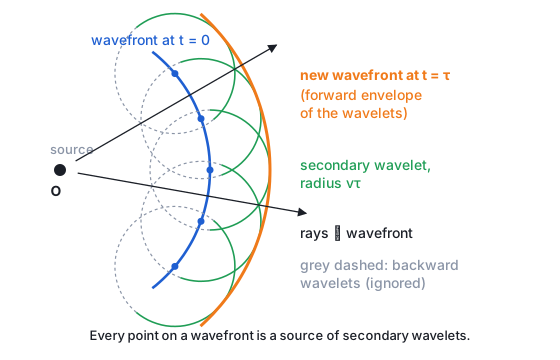
- A wavefront is a surface on which every point vibrates in the same phase. Rays are always perpendicular (normal) to the wavefront.
- Point source: spherical wavefront. Line source (slit): cylindrical. Far from any source, a small part looks like a plane wavefront.
- Huygens principle: every point on a wavefront is a source of secondary wavelets that spread at the wave speed. After time , the forward envelope (common tangent) of all wavelets is the new wavefront.
- Backward wavelets are ignored. Huygens just assumed this; later wave theory proved the backward amplitude is zero.
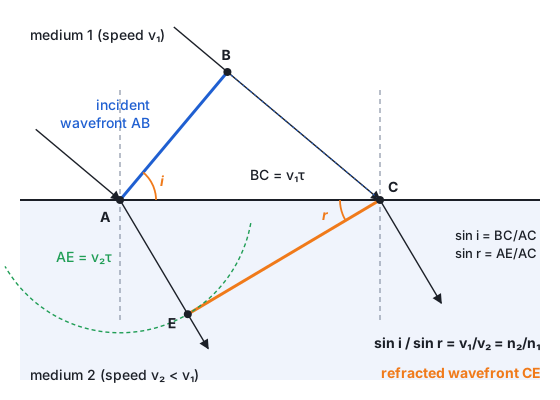
- Reflection by Huygens construction: the reflected wavefront makes the same angle with the surface as the incident one, so .
- Refraction: in time , the wave covers in medium 1 and in medium 2. This gives .
- So wave theory says light is SLOWER in a denser medium (). Newton's corpuscular theory predicted faster; experiment supports the wave theory.
- On refraction the frequency does not change. Speed and wavelength both drop by the factor : .
- Going from denser to rarer, the ray bends away from the normal; beyond the critical angle no refracted wavefront forms: total internal reflection.
- A thin prism only tilts a plane wavefront (it stays plane). A convex lens or a concave mirror turns it into a spherical wavefront converging to the focus.
Formulas
- Snell's law from Huygens construction
- speed, wavelength and frequency in a medium of index
- comparing two media (same frequency)
Tips, tricks and hacks
Common mistakes
✗ Wavelength stays the same and frequency changes in a new medium.
✓ Frequency is set by the source and stays fixed; and change.
✗ Rays are drawn along (parallel to) the wavefront.
✓ Rays are normal to the wavefront; for a plane wavefront the rays are parallel to each other.
✗ Corpuscular and wave theory both give light faster in water.
✓ Only corpuscular theory says faster; wave theory (and experiment) says slower, .
NEET traps
"Which theory predicts the speed of light in water is less than in air?" Answer: wave theory (Huygens), not corpuscular.
Shape question: a point source very far away (like the Sun) gives a plane wavefront, not a spherical one.
Huygens principle explains reflection, refraction and diffraction, but it does not by itself explain why there is no backwave.
Quick check: Light of wavelength 600 nm in air enters glass of refractive index 1.5. In glass its wavelength and frequency are
- 400 nm, Hz
- 900 nm, Hz
- 400 nm, Hz
- 600 nm, Hz
Answer: A. Hz stays the same; nm.
Topic 2 · 🔒
Interference and Young's double slit
Key points, graphs, every formula, tricks, common mistakes and NEET traps for this topic are inside Dhruv.
Start freeTopic 3 · 🔒
Diffraction
Key points, graphs, every formula, tricks, common mistakes and NEET traps for this topic are inside Dhruv.
Start freeTopic 4 · 🔒
Polarisation
Key points, graphs, every formula, tricks, common mistakes and NEET traps for this topic are inside Dhruv.
Start freePractise Wave Optics questions
Topic-wise practice from Level 1 to Level 3, NCERT-based questions and NEET PYQs, with a full solution after every answer.
Start practising free