Class 12 Physics · NCERT notes for NEET
Ray Optics and Optical Instruments: NCERT Notes, Formulas and Tricks for NEET
The ray model of light: mirrors, refraction and TIR, lenses, prisms, and microscopes and telescopes. It is one of the most-asked Class 12 chapters in NEET, mostly through sign-convention numericals, so practise signs until they are automatic.
- 1. Reflection and spherical mirrors
- 2. Refraction and total internal reflection 🔒
- 3. Lenses and lens maker's formula 🔒
- 4. Prism and dispersion 🔒
- 5. Optical instruments 🔒
Topic 1 is open for everyone. The full chapter, quick revision and practice open with a plan, or start free with 5 full chapters.
Open the interactive version (simulations and tap-to-answer quick checks).
Topic 1
Reflection and spherical mirrors
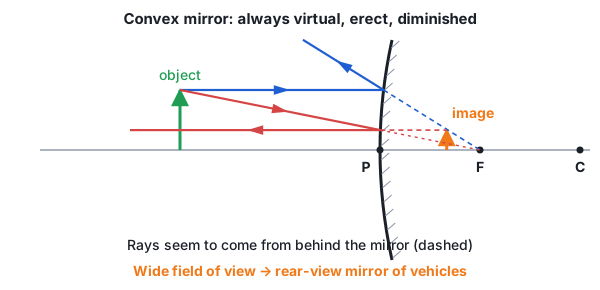
The mirror on a car's side says "objects in mirror are closer than they appear". It is convex: it shrinks everything so you can see more road.
- Laws of reflection: angle of incidence = angle of reflection, and the incident ray, reflected ray and normal lie in one plane. They hold for curved mirrors too, using the normal at the point of incidence.
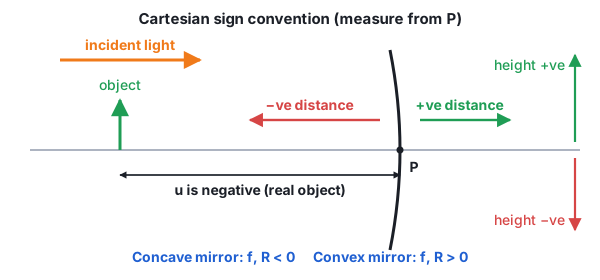
- Cartesian sign convention: measure every distance from the pole P. Along the incident light is , against it is . Heights above the axis are , below are .
- So for a real object, . A concave mirror has ; a convex mirror has .
- For paraxial rays, . The focus F lies midway between P and the centre of curvature C.
- Mirror equation works for both mirrors once you put the signs in.
- Magnification . : real and inverted. : virtual and erect. : magnified.
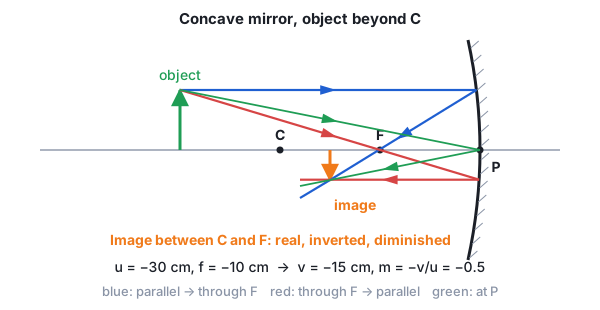
- Concave mirror: object beyond C gives a real image between C and F; object at C gives image at C (same size); object at F gives image at infinity; object between F and P gives a virtual, erect, magnified image (shaving mirror).
- Convex mirror: for any real object the image is virtual, erect, diminished and lies between P and F.
- Focal length of a mirror does not depend on the surrounding medium or on the colour of light, so mirrors have no chromatic aberration.
Formulas
- Paraxial rays; same sign as R
- Mirror equation, with signs
- Linear magnification of a mirror
- Mirror equation solved for v
- Magnification without finding v first
Tips, tricks and hacks
Common mistakes
✗ Putting cm for a concave mirror because "focal length is a length".
✓ With the Cartesian convention the focus of a concave mirror is in front (against the light), so cm.
✗ Using the lens formula for mirrors.
✓ Mirrors use and ; the minus-sign forms belong to lenses.
✗ Thinking a concave mirror always forms a real image.
✓ Object between F and P gives a virtual, erect, magnified image; that is how a shaving mirror works.
NEET traps
"Focal length of a mirror changes when it is dipped in water": FALSE. Only lenses change, because reflection does not involve n.
A question gives for a concave mirror and asks where the object is: positive m means virtual, so the object is between F and P, not beyond C.
Half the mirror painted black still forms the whole image, only dimmer.
Quick check: An object is 20 cm in front of a concave mirror of focal length 15 cm. The image is
- 60 cm in front, real, inverted, 3 times larger
- 60 cm behind, virtual, erect, 3 times larger
- 8.6 cm in front, real, inverted, smaller
- 12 cm behind, virtual, erect, smaller
Answer: A. cm (in front, real). : inverted and 3 times larger.
Topic 2 · 🔒
Refraction and total internal reflection
Key points, graphs, every formula, tricks, common mistakes and NEET traps for this topic are inside Dhruv.
Start freeTopic 3 · 🔒
Lenses and lens maker's formula
Key points, graphs, every formula, tricks, common mistakes and NEET traps for this topic are inside Dhruv.
Start freeTopic 4 · 🔒
Prism and dispersion
Key points, graphs, every formula, tricks, common mistakes and NEET traps for this topic are inside Dhruv.
Start freeTopic 5 · 🔒
Optical instruments
Key points, graphs, every formula, tricks, common mistakes and NEET traps for this topic are inside Dhruv.
Start freePractise Ray Optics and Optical Instruments questions
Topic-wise practice from Level 1 to Level 3, NCERT-based questions and NEET PYQs, with a full solution after every answer.
Start practising free