Class 12 Physics · NCERT notes for NEET
Electromagnetic Waves: NCERT Notes, Formulas and Tricks for NEET
How Maxwell's displacement current links changing E and B fields, why that gives a self-travelling EM wave, and the full spectrum from radio to gamma rays. A short, high-scoring chapter: NEET usually asks 1-2 direct questions on , displacement current, energy and momentum of the wave, or the order and uses of the bands.
Topic 1 is open for everyone. The full chapter, quick revision and practice open with a plan, or start free with 5 full chapters.
Open the interactive version (simulations and tap-to-answer quick checks).
Topic 1
Displacement current
A capacitor's gap is empty space, no charge ever jumps across it, yet a compass placed right next to the gap deflects while the capacitor charges.
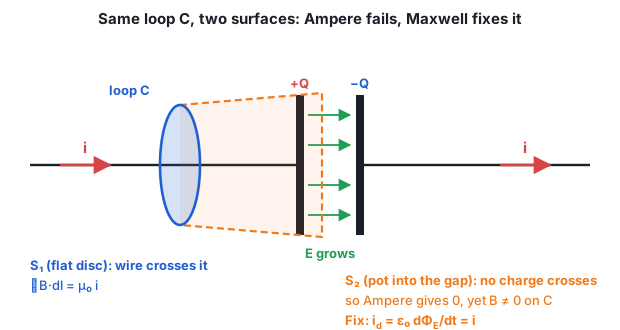
- Ampere's law fails for a charging capacitor: for the same loop, a surface through the wire encloses current , but a pot-shaped surface through the gap encloses none.
- Inside the gap the electric field grows: , so the flux changes at the rate .
- Maxwell added the displacement current . In the gap it is exactly equal to the conduction current in the wires.
- Ampere-Maxwell law: . The total current is continuous everywhere in the circuit.
- Displacement current is not a flow of charge, but it produces a magnetic field exactly like a conduction current. It exists even in vacuum.
- Steady (DC) fields give . In the wires ; in the gap . Both can exist together in a leaky dielectric.
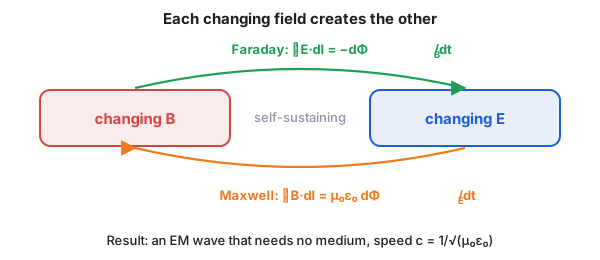
- Changing makes (Faraday) and changing makes (Maxwell). This two-way link lets fields travel by themselves as an EM wave.
- Maxwell's four equations: Gauss's law for , Gauss's law for (no monopoles), Faraday's law and the Ampere-Maxwell law.
- They predicted a wave speed m/s, equal to the measured speed of light: light is an EM wave.
- Hertz (1887) first produced and detected EM waves; J.C. Bose made waves of 25 mm to 5 mm; Marconi sent them over long distances.
Formulas
- displacement current; = electric flux
- parallel-plate capacitor, plate area A,
- Gauss's law (electricity)
- Gauss's law (magnetism): no magnetic monopoles
- Faraday's law
- Ampere-Maxwell law
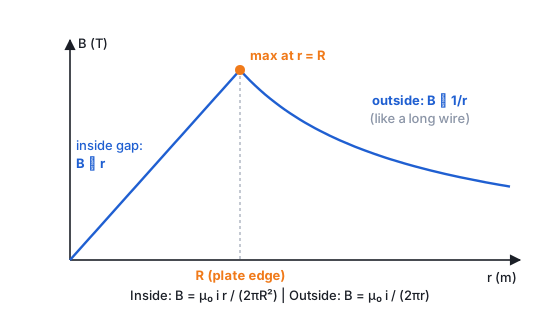
- field in and around the gap of a circular-plate capacitor of radius R
Tips, tricks and hacks
Common mistakes
✗ Displacement current is zero in the capacitor gap because no charge crosses it.
✓ Conduction current is zero there; displacement current equals the lead current .
✗ Displacement current is due to motion of bound charges or electrons.
✓ It is due only to a changing electric flux and exists even in perfect vacuum.
✗ B inside the gap is like a wire.
✓ Inside, only part of is enclosed, so , which grows with r.
✗ A fully charged capacitor with steady voltage still has a displacement current.
✓ With constant V, E is constant, , so (and ).
NEET traps
"Displacement current has the same magnitude as conduction current in the leads" is TRUE, even though it is not a flow of charge.
NEET asks for for between plates: ; the peak is . Do not forget the factor .
Which law of Maxwell's set says magnetic monopoles do not exist? Gauss's law for magnetism, , not Faraday's law.
Quick check: A parallel-plate capacitor of capacitance has its voltage changing at V/s. The displacement current between the plates is
- 0
- 0.1 A
- 1 A
- 10 A
Answer: C. A.
Topic 2 · 🔒
EM waves and the electromagnetic spectrum
Key points, graphs, every formula, tricks, common mistakes and NEET traps for this topic are inside Dhruv.
Start freePractise Electromagnetic Waves questions
Topic-wise practice from Level 1 to Level 3, NCERT-based questions and NEET PYQs, with a full solution after every answer.
Start practising free