Class 12 Physics · NCERT notes for NEET
Alternating Current: NCERT Notes, Formulas and Tricks for NEET
How resistors, inductors and capacitors behave with sinusoidal voltage, series LCR resonance, AC power and transformers. NEET usually asks one or two questions from it, mostly quick numericals on reactance, impedance, resonance and power factor.
- 1. AC voltage applied to R, L and C
- 2. Series LCR circuit and resonance 🔒
- 3. Power in AC circuits 🔒
- 4. Transformers 🔒
Topic 1 is open for everyone. The full chapter, quick revision and practice open with a plan, or start free with 5 full chapters.
Open the interactive version (simulations and tap-to-answer quick checks).
Topic 1
AC voltage applied to R, L and C
The 220 V written on your wall socket is not the peak: the voltage actually swings between +311 V and −311 V fifty times every second.
- An AC source gives ; is the peak (amplitude) and . Indian mains: Hz, so .
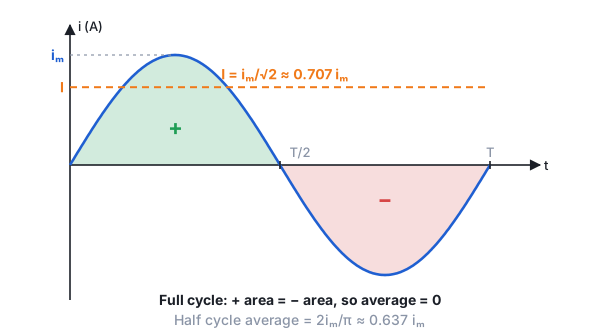
- RMS (effective) value: the steady current that gives the same heat in a resistor over a full cycle. , .
- Average of a sine current over a full cycle is zero. Over a half cycle it is .
- AC meters read rms values. The 220 V supply is rms, so the peak is V.
- Pure resistor: , in phase with . Heating goes as , so the average power is not zero.
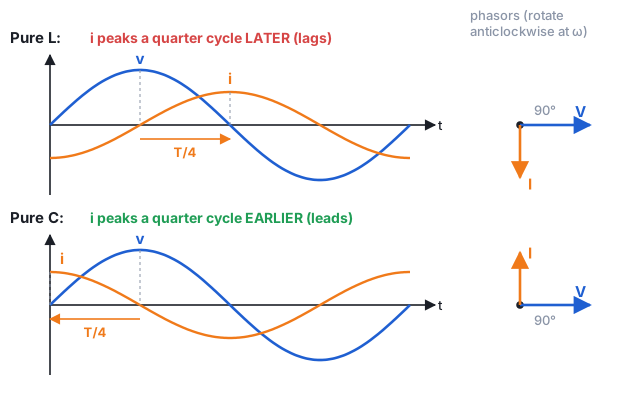
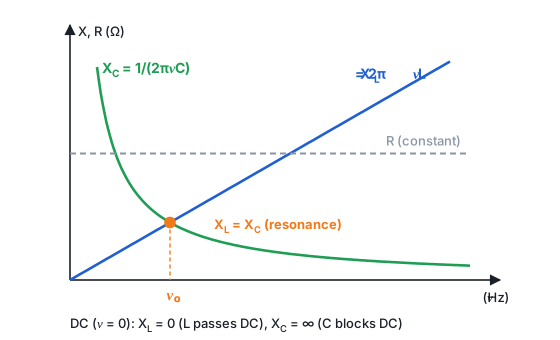
- Pure inductor: lags by (a quarter cycle). Inductive reactance rises with frequency; for DC .
- Pure capacitor: leads by . Capacitive reactance falls with frequency; for DC it is infinite, so C blocks DC.
- Reactance is measured in ohm like resistance, but it stores and returns energy instead of turning it into heat.
- Phasors are arrows that rotate anticlockwise at ; the vertical projection gives the instantaneous value. The angle between and phasors is the phase difference.
- Average power over a cycle is zero in a pure L and in a pure C: energy stored in one quarter cycle is given back in the next.
Formulas
- rms values from peak values
- mean value over a half cycle (full cycle gives 0)
- inductive reactance in ohm
- capacitive reactance in ohm
- pure inductor: current lags
- pure capacitor: current leads
Tips, tricks and hacks
Common mistakes
✗ Taking 220 V mains as the peak value.
✓ 220 V is rms; the peak is V.
✗ Saying the average value of AC is .
✓ That is for a half cycle. Over a full cycle the average is exactly zero.
✗ In an inductor the current leads the voltage.
✓ The inductor opposes change of current, so current builds up late: it lags by .
✗ Reactance wastes power like resistance because both are in ohm.
✓ Pure L and C only store and return energy; average power in them is zero.
NEET traps
NEET gives and asks the rms value or frequency: rms A and Hz, not 100 Hz.
Doubling frequency doubles but halves ; options often swap the two.
"A capacitor allows AC but blocks DC" is TRUE; "an inductor blocks DC" is FALSE (it offers zero reactance to steady DC).
Quick check: A H inductor is connected to a 220 V, 50 Hz supply (neglect its resistance). The rms current is
- 2.2 A
- 1.1 A
- 3.1 A
- 4.4 A
Answer: A. , so A.
Topic 2 · 🔒
Series LCR circuit and resonance
Key points, graphs, every formula, tricks, common mistakes and NEET traps for this topic are inside Dhruv.
Start freeTopic 3 · 🔒
Power in AC circuits
Key points, graphs, every formula, tricks, common mistakes and NEET traps for this topic are inside Dhruv.
Start freeTopic 4 · 🔒
Transformers
Key points, graphs, every formula, tricks, common mistakes and NEET traps for this topic are inside Dhruv.
Start freePractise Alternating Current questions
Topic-wise practice from Level 1 to Level 3, NCERT-based questions and NEET PYQs, with a full solution after every answer.
Start practising free