Class 12 Physics · NCERT notes for NEET
Electromagnetic Induction: NCERT Notes, Formulas and Tricks for NEET
How a changing magnetic flux produces an emf: Faraday's and Lenz's laws, motional emf, eddy currents, the AC generator, and self and mutual inductance. It is a short, formula-rich chapter, and NEET usually asks one or two direct questions from it, often a numerical on flux change, a moving rod or inductance.
Topic 1 is open for everyone. The full chapter, quick revision and practice open with a plan, or start free with 5 full chapters.
Open the interactive version (simulations and tap-to-answer quick checks).
Topic 1
Faraday's and Lenz's laws
Tap your metro card or charge your phone on a wireless pad: no wire touches anything, yet a current flows. A changing magnetic flux is doing all the work.
- Faraday and Henry found that an emf is induced in a coil whenever the magnetic flux through it changes: move a magnet near a coil, move a current-carrying coil, or switch the current in a nearby coil on or off.
- No change, no emf: a magnet held still inside a coil or a steady current in the nearby coil gives zero galvanometer deflection. An iron rod inside the coils makes the deflection larger.
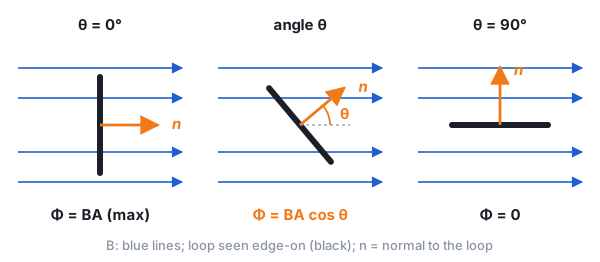
- Magnetic flux , where is the angle between and the normal to the area. Scalar; SI unit weber, .
- Flux can change in three ways: change , change the area , or change the angle (rotate the coil).
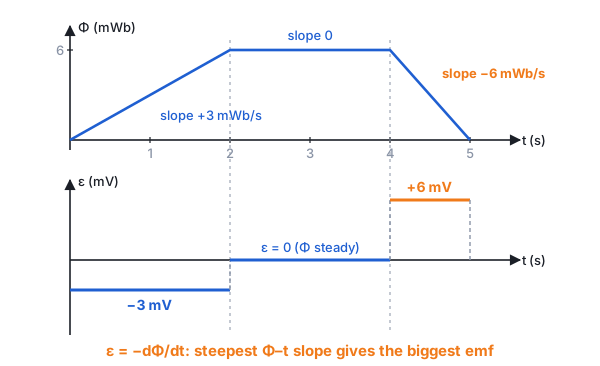
- Faraday's law: . The emf lasts only while the flux is changing. is called the flux linkage.
- Induced current , and the charge that flows is : it depends only on the total flux change, not on how fast it happens.
- Lenz's law: the induced current opposes the change in flux that produces it. The minus sign in Faraday's law expresses this.
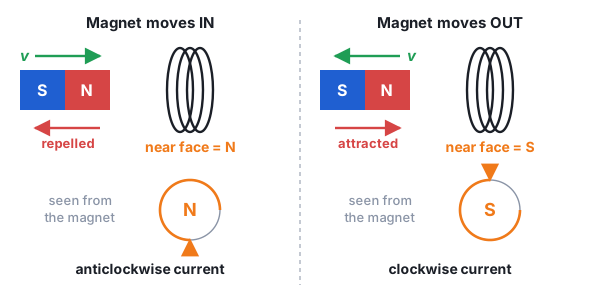
- N pole approaching a coil: the near face becomes N (anticlockwise current seen from the magnet) and repels it. N pole receding: the near face becomes S and attracts it.
- Lenz's law is energy conservation: you must do work against the opposing force, and that work appears as electrical energy (heat in the coil). If the induced current helped the change, energy would come from nothing.
- An open coil still has an induced emf; only the current is zero. NCERT example: a loop of area inside a solenoid of 15 turns/cm, current changed by 2 A in 0.1 s, gives V.
Formulas
- Uniform , flat area; between and the normal
- Faraday's law for turns; minus sign = Lenz's law
- Induced current in a closed coil of resistance
- Charge that flows; independent of time taken
- Average emf for a flux change in time
Tips, tricks and hacks
Common mistakes
✗ A large flux means a large induced emf.
✓ The emf depends on . A huge steady flux gives zero emf; zero flux can come with maximum emf (rotating coil).
✗ Taking in as the angle between and the plane of the loop.
✓ is measured from the normal. If the field makes with the plane, use .
✗ Lenz's law means the induced current always opposes the flux.
✓ It opposes the change in flux. When flux is decreasing, the induced current tries to support it, in the same direction as the original field.
✗ No current flows, so there is no induced emf in an open loop.
✓ The emf appears whenever flux changes; a closed path is needed only for current.
NEET traps
Weber is the unit of flux, tesla () is the unit of . Options often swap them; the dimensions of flux are .
"The induced charge depends on the rate of change of flux": FALSE. Emf and current depend on the rate; charge does not.
A ring dropped over a vertical magnet, or a magnet dropped through a ring: it is opposed both while entering and while leaving, so its acceleration is less than on both sides.
Quick check: The flux per turn through a 50-turn coil of resistance falls from 4 mWb to 1 mWb in 0.2 s. The charge that flows through the coil is
- 3 mC
- 30 mC
- 150 mC
- 0.6 mC
Answer: B. C mC. The 0.2 s does not matter.
Topic 2 · 🔒
Motional EMF and eddy currents
Key points, graphs, every formula, tricks, common mistakes and NEET traps for this topic are inside Dhruv.
Start freeTopic 3 · 🔒
Self and mutual inductance
Key points, graphs, every formula, tricks, common mistakes and NEET traps for this topic are inside Dhruv.
Start freePractise Electromagnetic Induction questions
Topic-wise practice from Level 1 to Level 3, NCERT-based questions and NEET PYQs, with a full solution after every answer.
Start practising free