Class 12 Physics · NCERT notes for NEET
Magnetism and Matter: NCERT Notes, Formulas and Tricks for NEET
The bar magnet as a magnetic dipole (field lines, axial and equatorial fields, torque, energy, Gauss's law) and how dia-, para- and ferromagnetic materials respond to a field. It is a short chapter; NEET usually asks one question from it, most often on the classification of materials or the dipole formulas.
Topic 1 is open for everyone. The full chapter, quick revision and practice open with a plan, or start free with 5 full chapters.
Open the interactive version (simulations and tap-to-answer quick checks).
Topic 1
Bar magnet as a magnetic dipole
Break a fridge magnet into ten pieces and you get ten complete magnets, each with its own N and S: nobody has ever found a lone magnetic pole.
- A freely suspended magnet settles roughly along north-south. Like poles repel, unlike poles attract.
- Poles always come in pairs: cutting a magnet gives two smaller magnets. Isolated magnetic monopoles are not known.
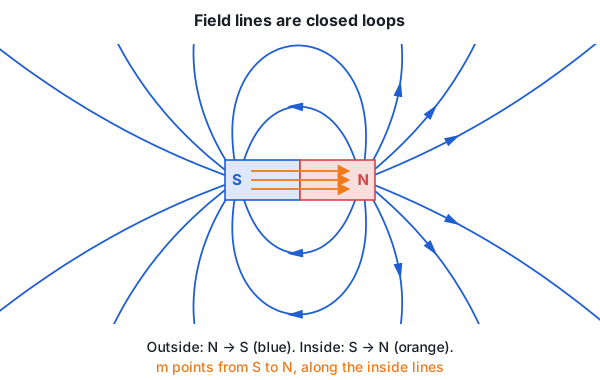
- Field lines are continuous closed loops: outside the magnet they run from N to S, inside from S to N. They never cross; the tangent gives the direction of and crowding shows strength.
- A bar magnet and a current-carrying solenoid have the same external field pattern, so a bar magnet can be treated as an equivalent solenoid. A current loop has moment .
- Magnetic moment points from S to N. SI unit , which is the same as .
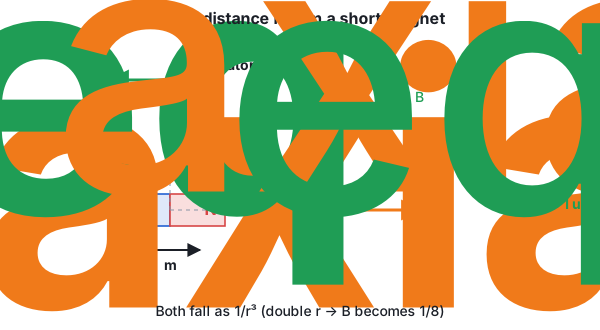
- For a short magnet (): axial field along ; equatorial field opposite to . So at equal distance.
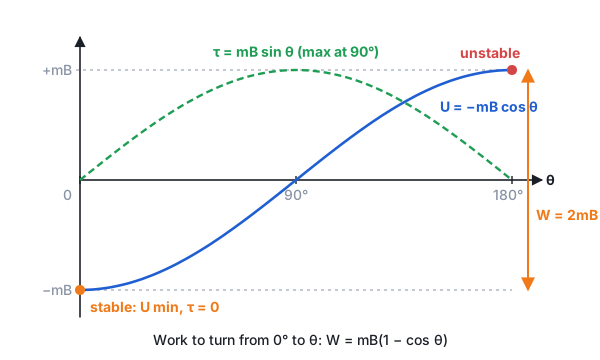
- In a uniform field there is no net force on a magnet, only a torque that turns towards .
- Potential energy : minimum (, stable) at and maximum (, unstable) at .
- A magnet slightly displaced in a uniform field oscillates in SHM with ; this is how or is measured.
- Gauss's law for magnetism: the net magnetic flux through any closed surface is zero, , because there are no monopoles.
Formulas
- On the axis of a short magnet, along
- On the equatorial line, opposite to
- Exact axial field, = magnetic length
- ,Pole strength times magnetic length; current loop
- ,Torque in a uniform field
- Potential energy of the dipole
- Work to rotate from to
- Small oscillations; = moment of inertia
- Gauss's law for magnetism
Tips, tricks and hacks
Common mistakes
✗ Field lines go from N to S everywhere, including inside the magnet.
✓ Inside they go S to N; that is what makes them closed loops with zero net flux.
✗ Torque is maximum when the magnet is along the field.
✓ At torque is zero (equilibrium); it is maximum at .
✗ The equatorial field points along , like the axial field.
✓ On the equatorial line is antiparallel to , while on the axis it is parallel.
✗ A closed surface around only the N pole has non-zero flux.
✓ You cannot enclose only one pole: lines that leave also return through the magnet, so flux is zero.
NEET traps
"A magnet in a uniform field experiences a force and a torque": false, only a torque; a non-uniform field is needed for a net force.
Both and are correct units of ; NEET may offer one of them as the "wrong" option.
Work is , but work is only ; read the starting angle.
Quick check: A short bar magnet gives T at a point on its axis 10 cm from its centre. The field at a point on its equatorial line 20 cm from the centre is
- T
- T
- T
- T
Answer: B. Equatorial at 10 cm T. Doubling divides by 8: T.
Topic 2 · 🔒
Magnetic properties of materials
Key points, graphs, every formula, tricks, common mistakes and NEET traps for this topic are inside Dhruv.
Start freePractise Magnetism and Matter questions
Topic-wise practice from Level 1 to Level 3, NCERT-based questions and NEET PYQs, with a full solution after every answer.
Start practising free