Class 12 Physics · NCERT notes for NEET
Moving Charges and Magnetism: NCERT Notes, Formulas and Tricks for NEET
How currents make magnetic fields and how those fields push on moving charges, wires and coils, ending with the moving coil galvanometer. NEET regularly asks from it: radius and period of circular motion, fields of wires, loops and solenoids, force between wires and meter conversion.
- 1. Magnetic force on moving charges
- 2. Biot-Savart law 🔒
- 3. Ampere's circuital law and solenoids 🔒
- 4. Force and torque on current carrying conductors 🔒
- 5. Moving coil galvanometer 🔒
Topic 1 is open for everyone. The full chapter, quick revision and practice open with a plan, or start free with 5 full chapters.
Open the interactive version (simulations and tap-to-answer quick checks).
Topic 1
Magnetic force on moving charges
The aurora is charged particles from the Sun spiralling along Earth's field lines into the polar sky. A magnetic field can steer a charge, but it can never speed it up.
- Oersted (1820) saw a compass needle deflect near a current-carrying wire: moving charges produce a magnetic field.
- Force on a charge moving with in field : , size . With an electric field too, the Lorentz force is .
- The magnetic force is zero if the charge is at rest or moves along ( or ). It is largest, , when .
- always, so the magnetic force does no work: speed and kinetic energy never change, only the direction does.
- SI unit of : tesla, . Also ; Earth's field is of the order of .
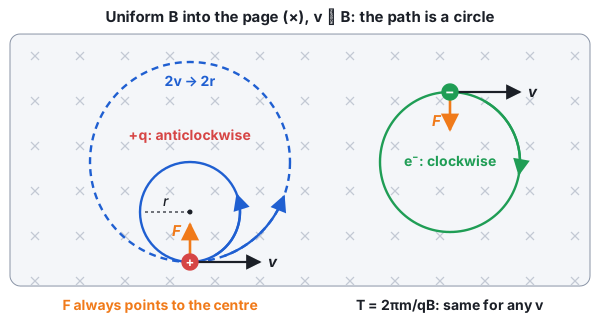
- : uniform circular motion with , so . The period does not depend on or .
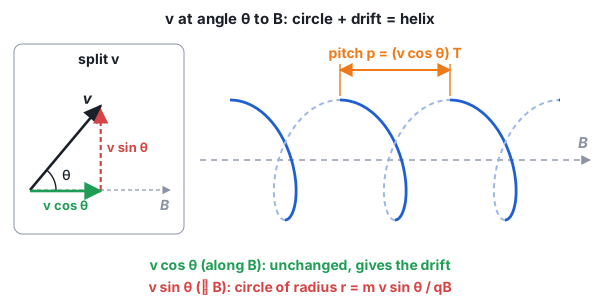
- at angle to : along is unchanged and gives a circle, so the path is a helix with pitch .
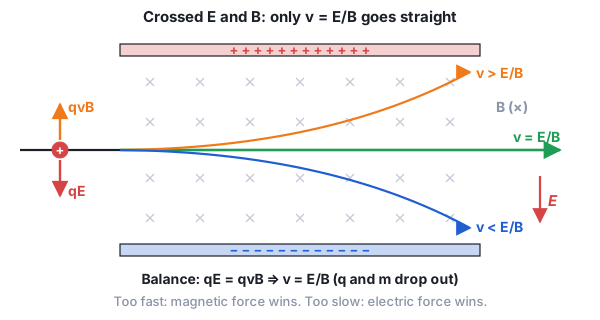
- Velocity selector: , and mutually perpendicular. Only particles with pass undeflected, whatever their charge or mass (used by J.J. Thomson for ).
- Direction: for a positive charge use the right-hand rule for (or Fleming's left-hand rule). For an electron, reverse the answer.
Formulas
- Lorentz force
- = angle between and
- Radius for ; = kinetic energy
- Period, independent of speed
- Frequency and angular frequency of revolution
- Pitch of the helix
- Radius of the helix
- Undeflected speed in crossed fields
Tips, tricks and hacks
Common mistakes
✗ Magnetic force can speed up or slow down a charge.
✓ , so work is zero and speed is constant; only an electric field changes speed.
✗ A faster particle in the same field takes longer to go round.
✓ Bigger gives bigger in the same ratio, so is unchanged.
✗ Using for the pitch of the helix.
✓ Pitch is distance along in one period, so it uses ; radius uses .
✗ Applying the right-hand rule to an electron and keeping the answer.
✓ The rule gives the force on a positive charge; reverse it for negative charges.
NEET traps
A neutron, or any charge moving parallel to , goes straight undeflected. NEET may call this "no force even though ": TRUE.
"Kinetic energy of a charge in a uniform magnetic field stays constant" is TRUE, but momentum (a vector) keeps changing.
The velocity selector condition does not depend on charge, sign or mass: electrons and protons at that speed both go straight.
Quick check: A proton and an particle enter the same uniform magnetic field perpendicular to it with the same speed. The ratio of their radii is
- 1
- 2
- 1/2
- 4
Answer: B. : .
Topic 2 · 🔒
Biot-Savart law
Key points, graphs, every formula, tricks, common mistakes and NEET traps for this topic are inside Dhruv.
Start freeTopic 3 · 🔒
Ampere's circuital law and solenoids
Key points, graphs, every formula, tricks, common mistakes and NEET traps for this topic are inside Dhruv.
Start freeTopic 4 · 🔒
Force and torque on current carrying conductors
Key points, graphs, every formula, tricks, common mistakes and NEET traps for this topic are inside Dhruv.
Start freeTopic 5 · 🔒
Moving coil galvanometer
Key points, graphs, every formula, tricks, common mistakes and NEET traps for this topic are inside Dhruv.
Start freePractise Moving Charges and Magnetism questions
Topic-wise practice from Level 1 to Level 3, NCERT-based questions and NEET PYQs, with a full solution after every answer.
Start practising free