Class 12 Physics · NCERT notes for NEET
Current Electricity: NCERT Notes, Formulas and Tricks for NEET
How charges move through conductors: drift, Ohm's law, resistivity, cells, Kirchhoff's rules, bridges and power. NEET regularly asks numericals from it (combinations, cells, bridges, power), so it is a chapter worth mastering fully.
- 1. Current, drift velocity and Ohm's law
- 2. Resistivity and its temperature dependence
- 3. Combination of resistors
- 4. Cells, EMF and internal resistance
- 5. Kirchhoff's rules
- 6. Wheatstone bridge and meter bridge
- 7. Electrical energy and power
- Quick revision
Free chapter: the full notes are open for everyone.
Open the interactive version (simulations and tap-to-answer quick checks).
Topic 1
Current, drift velocity and Ohm's law
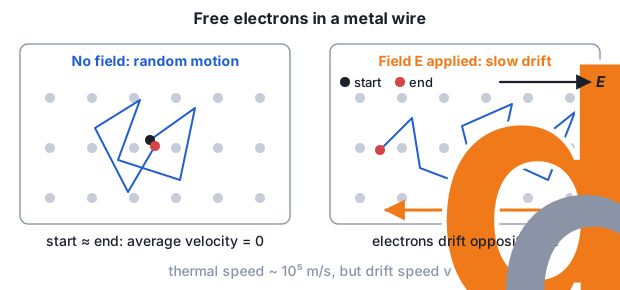
Electrons in a copper wire crawl at about 1 mm per second, yet the fan starts the moment you flip the switch. The field travels, not the electrons.
- Electric current is the rate of flow of charge: . SI unit ampere, .
- Current has a direction but is a scalar: currents at a junction add algebraically, not by the vector law. Conventional current is opposite to electron flow.
- Current density = current per unit normal area, a vector with unit ; .
- With no field, free electrons move randomly at thermal speeds (about ), but their average velocity is zero, so no net current.
- In a field every electron gets a small extra average velocity opposite to , the drift velocity .
- Relaxation time is the average time between two successive collisions with ions; for metals it is about .
- Mobility is drift speed per unit field; SI unit . It is positive for both electrons and holes.
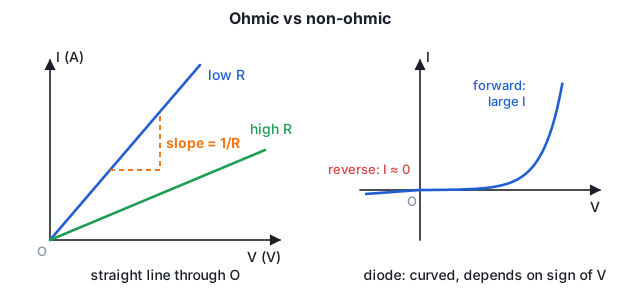
- Ohm's law: at constant temperature and physical conditions, , so . Its vector (microscopic) form is .
- Resistance (unit ohm, ) depends on material, length, area and temperature, not on or .
- Non-ohmic behaviour: - graph is not a straight line, depends on the sign of (diode), or the same occurs at more than one (GaAs).
Formulas
- = free electrons per , = cross-section, = drift speed
- minus sign: electrons drift opposite to
- current density
- mobility
- Ohm's law (macroscopic form)
Tips, tricks and hacks
Common mistakes
✗ Current is a vector because it has a direction.
✓ Current does not obey vector addition, so it is a scalar. Current density is the vector.
✗ The bulb lights instantly because electrons rush through the wire.
✓ Electrons drift at about ; the electric field sets up almost at the speed of light and pushes all electrons at once.
✗ Resistance changes when you increase the voltage.
✓ For an ohmic conductor stays constant; changes only with material, size or temperature.
NEET traps
'Drift velocity depends on the area of the wire' is false at fixed () but true at fixed (). Read which one is held constant.
NCERT: Ohm's law is not a fundamental law. Diodes, thermistors and GaAs are standard non-ohmic options.
An - graph of one wire at two temperatures: the line with the smaller slope is at the higher temperature (larger ).
Quick check: A wire carries a steady current. At a section where the radius is half of that at another section, the drift speed is
- the same
- half
- double
- four times
Answer: D. Same through both sections, so ; half radius gives .
Topic 2
Resistivity and its temperature dependence
The heating coil of your electric iron is nichrome, not copper: high resistivity, and it hardly changes even when the coil glows red hot.
- Resistance of a uniform wire: . Resistivity (unit ) is a property of the material and temperature only.
- Conductivity , unit ().
- Ranges: metals to ; insulators like glass and rubber are to times more resistive; semiconductors (Si, Ge) lie in between.
- From the drift model, : more free electrons or longer time between collisions means lower .
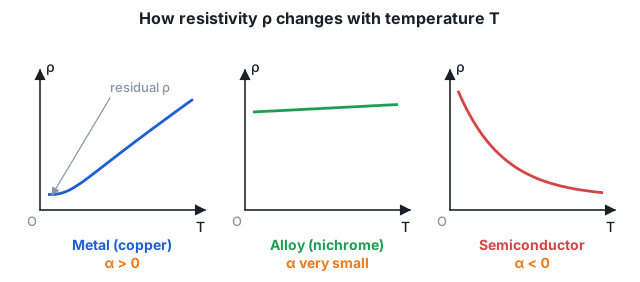
- Metals: when rises, ions vibrate more, falls, so rises. hardly changes.
- Over a limited range , where is the temperature coefficient of resistivity (unit ).
- Semiconductors and insulators: falls as rises because increases sharply, so is negative.
- Alloys like nichrome, manganin and constantan have high and very small . Manganin and constantan are used in standard resistors; nichrome in heaters.
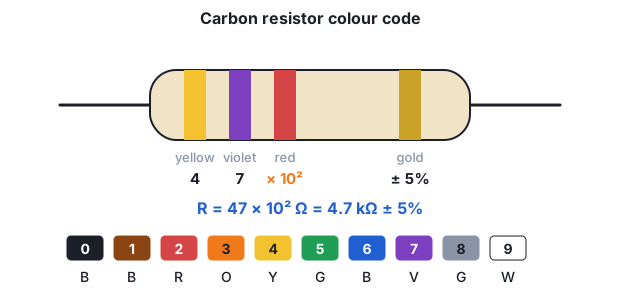
- Tolerance band: gold , silver , no band .
Formulas
- uniform conductor
- resistivity from the drift model
- conductivity
- temperature dependence, limited range
- temperature coefficient from two readings
- wire stretched to times its length, volume constant
Tips, tricks and hacks
Common mistakes
✗ Cutting a wire in half halves its resistivity.
✓ Resistance halves; resistivity is a material property and does not change.
✗ Stretching a wire to double length doubles its resistance.
✓ Area also halves (same volume), so becomes 4 times.
✗ All materials have resistance increasing with temperature.
✓ Only metals. Semiconductors and insulators have negative ; alloys have very small .
NEET traps
NEET asks which material is used for standard resistors: manganin or constantan, because of high and very low , not copper.
The temperature coefficient of a semiconductor is negative because rises with ; actually falls, but the rise in wins.
Quick check: A wire of resistance is drawn so that its radius becomes half. Its new resistance is
Answer: D. Volume constant: half radius gives one-fourth area and 4 times length, so .
Topic 3
Combination of resistors
All the lights and fans in your home are in parallel. That is why switching off one fan does not plunge the room into darkness.
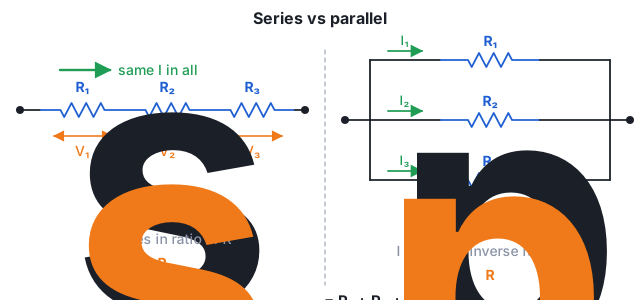
- Series: the same current flows through each resistor; the applied voltage divides in the ratio of the resistances.
- Series equivalent: ; it is always larger than the largest resistor.
- Parallel: the same potential difference is across each resistor; the total current divides in the inverse ratio of the resistances.
- Parallel equivalent: ; it is always smaller than the smallest resistor.
- equal resistors : series gives , parallel gives , and .
- Two in parallel: , and the current in is (the other resistor on top).
- Adding one more resistor in parallel always lowers the total; adding one in series always raises it.
- Points at the same potential can be joined or separated without changing currents; use symmetry to find such points in networks.
Formulas
- series
- parallel
- two resistors in parallel: product over sum
- voltage divider, series pair
- current divider, parallel pair
Tips, tricks and hacks
Common mistakes
✗ In parallel, the larger resistor takes the larger current.
✓ Same across each, so : the smaller resistor takes more current.
✗ Writing , forgetting the reciprocal.
✓ gives ; always flip at the end.
✗ Two resistors drawn one above the other are always in parallel.
✓ Parallel means both ends are joined to the same two nodes; check the nodes, not the drawing.
NEET traps
Cutting into parts and joining in parallel gives , not .
Household appliances are in parallel so each gets the full mains voltage and works independently.
A wire with zero resistance across a resistor shorts it: no current flows through that resistor.
Quick check: Three resistors of , and are in parallel. The equivalent resistance is
Answer: B. , so (below the smallest, ).
Topic 4
Cells, EMF and internal resistance
A car battery can push 100 A to start the engine, while a pencil cell of similar voltage cannot. The difference is internal resistance.
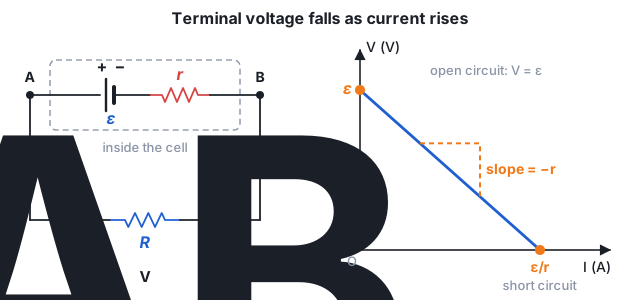
- EMF is the potential difference between the terminals of a cell when no current is drawn (open circuit). Despite the name, it is not a force.
- Internal resistance is the resistance of the electrolyte and electrodes inside the cell.
- Discharging through external : and terminal voltage , which is less than .
- Charging (current pushed into the terminal): , which is more than .
- Short circuit (): and . A car battery has very small , so it gives a large current.
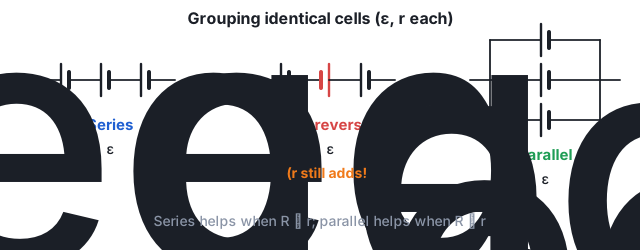
- Series cells: emfs add (a reversed cell subtracts), but internal resistances always add.
- Two cells in parallel: , .
- identical cells: series gives , ; parallel gives , .
- Mixed grouping ( rows in parallel, cells in series per row): , maximum when .
Formulas
- single cell with external
- terminal voltage, discharging
- internal resistance from , and
- two cells in parallel
- mixed grouping; at
Tips, tricks and hacks
Common mistakes
✗ Terminal voltage always equals emf.
✓ Only when . It is less while discharging and more while charging.
✗ Reversing one cell in series also reduces the internal resistance.
✓ Internal resistances always add, whatever the polarity: .
✗ Two cells in parallel give double the emf.
✓ Identical cells in parallel keep emf ; only becomes .
NEET traps
'Terminal p.d. can exceed emf': TRUE, while the cell is being charged ().
Two identical cells in parallel with one reversed: net emf zero and they drive a circulating current between them; NEET may ask the emf (zero).
Short-circuit current is the -intercept of the - graph.
Quick check: A cell of emf 2 V and internal resistance is connected to a resistor. The terminal voltage is
- 2.0 V
- 1.75 V
- 1.5 V
- 0.25 V
Answer: B. A; V (also ).
Topic 5
Kirchhoff's rules
Water pipes never pile up water at a joint, and walking round a hill brings you back to the same height. Kirchhoff's two rules are just these two ideas for circuits.
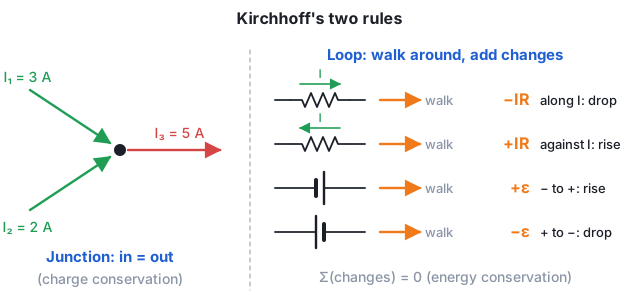
- Junction rule: at any junction, total current entering = total current leaving, .
- The junction rule is conservation of charge: in steady state, no charge piles up at a junction.
- Loop rule: the algebraic sum of potential changes around any closed loop is zero.
- The loop rule is conservation of energy: the electrostatic field is conservative, so you return to the same potential.
- Signs: crossing a resistor along the assumed current, change ; against it, . Crossing a cell from to , change ; from to , .
- Assume any directions for unknown currents. A negative answer only means the real current is opposite.
- Use the junction rule first to reduce the number of unknown currents, then write one loop equation per remaining unknown.
- The rules hold for any network, including non-linear elements, as long as currents are steady.
Formulas
- junction rule
- loop rule, with signs fixed by the direction of walking
- potential difference between two points along any path
Tips, tricks and hacks
Common mistakes
✗ The junction rule comes from conservation of energy.
✓ Junction rule = charge conservation; loop rule = energy conservation.
✗ Crossing a cell always adds .
✓ The sign depends on the direction of walking: to is a rise (), to is a drop (), whatever the current direction.
✗ A negative current means the answer is wrong.
✓ It only means the true direction is opposite to the one you assumed; the magnitude is correct.
NEET traps
NEET pairs the two rules with conservation laws and swaps them in options. Junction = charge, loop = energy.
For the drop across a cell carrying current, use or depending on the current direction, not just .
Quick check: Kirchhoff's loop rule is a consequence of the conservation of
- charge
- energy
- momentum
- mass
Answer: B. The electrostatic field is conservative, so the net change in potential (energy per unit charge) around a closed loop is zero.
Topic 6
Wheatstone bridge and meter bridge
A Wheatstone bridge measures resistance by looking for nothing: the galvanometer showing zero is the most accurate reading you can get.
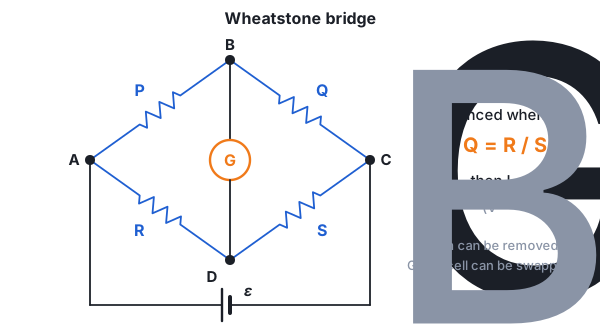
- A Wheatstone bridge has four resistors in a closed loop, a cell across one diagonal and a galvanometer across the other.
- Balanced (null) condition: no current through the galvanometer when , that is, and are at the same potential.
- At balance the galvanometer arm can be removed (or replaced by any resistor) without changing other currents.
- At balance the cell and galvanometer can be interchanged and the bridge stays balanced.
- The bridge is most sensitive when all four resistances are of the same order.
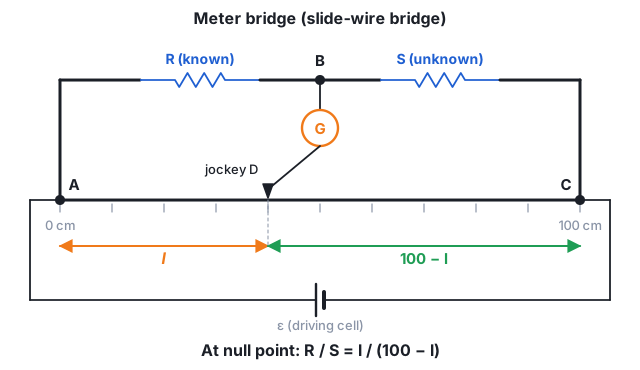
- A meter bridge is a practical Wheatstone bridge: a 1 m uniform wire forms two arms; a jockey slides on it to find the null point.
- If the null point is at length cm from the end (the end next to ), then .
- Thick copper strips keep connection resistance negligible. Getting the null point near the middle and interchanging and reduce end errors.
Formulas
- balanced bridge
- meter bridge; in cm from the end next to
- unknown resistance from a meter bridge
Tips, tricks and hacks
Common mistakes
✗ At balance no current flows anywhere in the bridge.
✓ Only the galvanometer current is zero; all four arms carry current.
✗ In a meter bridge, can be measured from either end.
✓ is from the end next to the known resistor ; from the other end the formula uses .
✗ The balance condition depends on the emf of the cell.
✓ It depends only on the four resistances; the cell emf does not appear.
NEET traps
Balance condition written as is the same condition (cross-multiply: ); do not reject it as wrong.
Changing the emf of the cell or the galvanometer resistance does not shift the null point.
Quick check: In a meter bridge, the null point is at 40 cm with a known resistor in the left gap. The unknown resistance in the right gap is
Answer: B. .
Topic 7
Electrical energy and power
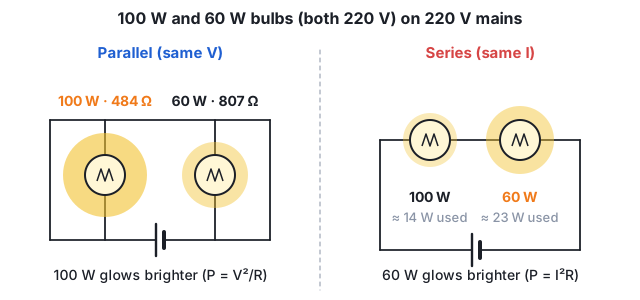
Join a 100 W and a 60 W bulb in series across the mains, and the 60 W bulb shines brighter. Most students bet the wrong way.
- In time , charge falls through p.d. , so the energy given is ; in a resistor it appears as heat (Joule heating).
- Power: , unit watt (W).
- Energy . Commercial unit: (1 'unit' on your bill).
- Series (same ): , so the larger resistor dissipates more. Parallel (same ): , so the smaller resistor dissipates more.
- A bulb rated at has : higher wattage means lower resistance. At voltage it gives .
- Power is sent at high voltage: for fixed , current is small, so line loss is small.
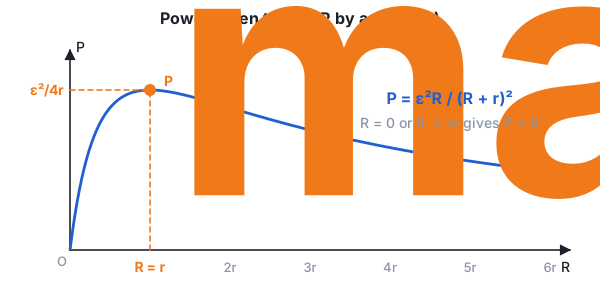
- A cell (, ) gives maximum power to external when : , and efficiency is then only 50%.
- Total power in any combination (series or parallel) is the sum of the powers in each resistor.
Formulas
- power in a resistor
- Joule heat in time
- resistance of an appliance rated ,
- transmission loss, power sent at voltage through line resistance
- maximum power transfer, at
- two appliances (same rated V) in series across that V
Tips, tricks and hacks
Common mistakes
✗ A 100 W bulb always glows brighter than a 60 W bulb.
✓ Only in parallel (same V). In series the 60 W bulb has higher R and glows brighter.
✗ Maximum power transfer means maximum efficiency.
✓ At efficiency is only 50%; efficiency keeps rising with .
✗ shows power always increases with .
✓ Only at fixed . At fixed , decreases with . Use the form where the fixed quantity appears.
NEET traps
'1 kWh' is a unit of energy, not power: J.
Fuse wire question: fuse is in series and melts by heating; it must have low melting point and suitable resistance.
High-voltage transmission reduces loss because current falls, not because resistance of the line changes.
Quick check: Two bulbs rated 40 W and 60 W, both at 220 V, are joined in series across 220 V. Which is correct?
- The 60 W bulb glows brighter
- Both glow equally
- The 40 W bulb glows brighter
- Total power is 100 W
Answer: C. In series the same flows and ; the 40 W bulb has larger , so it is brighter. Total is W.
Quick revision: Current Electricity the night before NEET
- ; , thermal speed , s.
- Same in a non-uniform wire: ; current is a scalar, is a vector.
- (Ohm's law, vector form); , unit .
- depends only on material and temperature.
- Stretch to times length: ; radius halved: .
- Metals ; semiconductors ; manganin and constantan: very small (standard resistors).
- Series largest; parallel smallest; equal: .
- (discharging), (charging); short-circuit .
- Series cells: always adds, even if a cell is reversed; parallel identical cells: , .
- Junction rule = charge conservation; loop rule = energy conservation.
- Balanced bridge: , ; meter bridge .
- ; J.
- Bulbs in series: lower wattage glows brighter; in parallel: higher wattage glows brighter.
- Maximum power to load at : , efficiency 50%.
Practise Current Electricity questions
Topic-wise practice from Level 1 to Level 3, NCERT-based questions and NEET PYQs, with a full solution after every answer.
Start practising free