Class 12 Physics · NCERT notes for NEET
Electrostatic Potential and Capacitance: NCERT Notes, Formulas and Tricks for NEET
Potential, equipotentials, potential energy, conductors, dielectrics and capacitors. NEET asks a few questions from this chapter almost every year, most often on capacitor combinations, the effect of a dielectric and stored energy.
- 1. Electric potential
- 2. Equipotential surfaces and E-V relation 🔒
- 3. Potential energy of a system of charges 🔒
- 4. Electrostatics of conductors 🔒
- 5. Dielectrics and polarisation 🔒
- 6. Capacitors and the parallel plate capacitor 🔒
- 7. Capacitors in series and parallel 🔒
- 8. Energy stored in a capacitor 🔒
Topic 1 is open for everyone. The full chapter, quick revision and practice open with a plan, or start free with 5 full chapters.
Open the interactive version (simulations and tap-to-answer quick checks).
Topic 1
Electric potential
A bird sits safely on an 11 kV line: it touches only one wire, so there is no potential DIFFERENCE across its body. Potential, not field, decides who gets a shock.
- The electrostatic force is conservative, so the work done in moving a charge slowly (no acceleration) depends only on the start and end points, not on the path.
- Potential at a point work done by an external agent to bring a unit positive charge from infinity to that point without acceleration. It is a scalar; .
- Potential difference: .
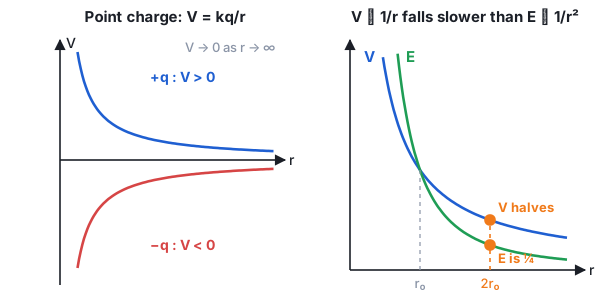
- Point charge: with at infinity. Positive for , negative for , falls as (slower than ).
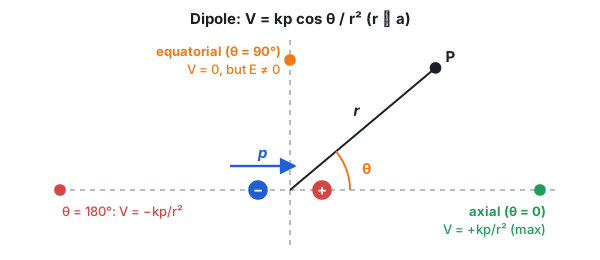
- Short dipole (): . Largest on the axis, zero on the whole equatorial plane, falls as .
- A dipole's potential depends on both and (angle between and ); a point charge's potential depends only on .
- Many charges: add the potentials as scalars with their signs, .
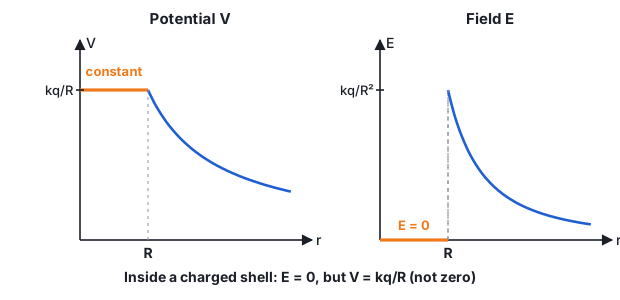
- Thin shell of radius : outside ; on the surface and everywhere inside , a constant (because inside).
- does not imply , and does not imply . Midway between and : but .
Formulas
- Potential (or potential difference) in volts,
- Point charge, at infinity;
- Short dipole; measured from
- Potential difference from the field
- Same at every inside point, including the centre
Tips, tricks and hacks
Common mistakes
✗ Adding potentials of several charges as vectors.
✓ Potential is a scalar: add with signs. Only fields add as vectors.
✗ Inside a charged shell , so too.
✓ means is constant, not zero; it equals the surface value .
✗ Using from one end of the dipole in .
✓ Measure and from the centre of the dipole, and the formula needs .
NEET traps
"At the centre of a charged ring/shell the field is zero, so the potential is zero": false. for both.
NEET asks the number of points on the line of two unlike charges where (two: one between, one outside near the smaller charge) and where (one, outside near the smaller charge).
Work done in moving a charge between two points of equal potential is zero, whatever the path, even through a strong field.
Quick check: Charges C and C are 30 cm apart. The point between them where the potential is zero is
- 6 cm from the C charge
- 24 cm from the C charge
- 15 cm from either charge
- there is no such point between them
Answer: B. gives , so cm from the C charge (6 cm from the C charge).
Topic 2 · 🔒
Equipotential surfaces and E-V relation
Key points, graphs, every formula, tricks, common mistakes and NEET traps for this topic are inside Dhruv.
Start freeTopic 3 · 🔒
Potential energy of a system of charges
Key points, graphs, every formula, tricks, common mistakes and NEET traps for this topic are inside Dhruv.
Start freeTopic 4 · 🔒
Electrostatics of conductors
Key points, graphs, every formula, tricks, common mistakes and NEET traps for this topic are inside Dhruv.
Start freeTopic 5 · 🔒
Dielectrics and polarisation
Key points, graphs, every formula, tricks, common mistakes and NEET traps for this topic are inside Dhruv.
Start freeTopic 6 · 🔒
Capacitors and the parallel plate capacitor
Key points, graphs, every formula, tricks, common mistakes and NEET traps for this topic are inside Dhruv.
Start freeTopic 7 · 🔒
Capacitors in series and parallel
Key points, graphs, every formula, tricks, common mistakes and NEET traps for this topic are inside Dhruv.
Start freeTopic 8 · 🔒
Energy stored in a capacitor
Key points, graphs, every formula, tricks, common mistakes and NEET traps for this topic are inside Dhruv.
Start freePractise Electrostatic Potential and Capacitance questions
Topic-wise practice from Level 1 to Level 3, NCERT-based questions and NEET PYQs, with a full solution after every answer.
Start practising free