Class 12 Physics · NCERT notes for NEET
Electric Charges and Fields: NCERT Notes, Formulas and Tricks for NEET
Charge and its properties, Coulomb's law, the electric field and field lines, the dipole, and Gauss's law with its standard results. It is the base for all of electrostatics, and NEET regularly asks on dipoles, flux and Gauss's law results.
- 1. Electric charge and its properties
- 2. Coulomb's law and superposition
- 3. Electric field
- 4. Electric field lines
- 5. Electric dipole
- 6. Electric flux and Gauss's law
- 7. Applications of Gauss's law
- Quick revision
Free chapter: the full notes are open for everyone.
Open the interactive version (simulations and tap-to-answer quick checks).
Topic 1
Electric charge and its properties
Pull off a woollen sweater on a dry winter night and you hear it crackle: you have just moved billions of electrons, but you have not created a single charge.
- There are two kinds of charge, positive and negative. Like charges repel and unlike charges attract. Naming the charge on a glass rod rubbed with silk as positive is a convention set by Franklin.
- Charging by rubbing (friction) moves electrons from one body to another; it does not create charge. Glass rubbed with silk becomes positive (it loses electrons), and the silk becomes negative.
- Conductors, such as metals, the human body and the Earth, let charge move freely. Insulators, such as glass, plastic and rubber, do not. Earthing (grounding) means sharing a body's charge with the Earth.
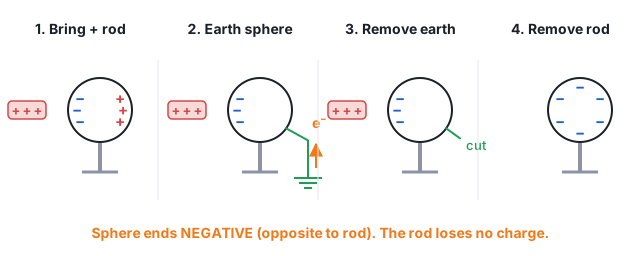
- Charging by induction: bring a charged rod near a conductor, earth the conductor, break the earth connection, then remove the rod. The conductor ends up with charge opposite to the rod's, and the rod does not lose any charge.
- A charged body can attract a neutral body because it induces (polarises) opposite charge on the nearer side.
- Additivity: the total charge is the algebraic sum of the individual charges. Charge is a scalar.
- Conservation: the total charge of an isolated system stays constant. Charges can be created or destroyed only in equal and opposite pairs, as in pair production.
- Quantisation: with an integer and . At large scales charge can be treated as continuous.
- One coulomb is about electrons' worth of charge. Charge is also invariant: it does not depend on the speed of the body.
- A body's mass changes very slightly on charging. A negatively charged body gains electrons and so gains a tiny mass.
Formulas
- Quantisation; is an integer, C
- Number of electrons transferred to give charge
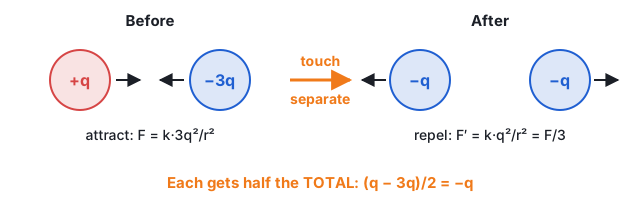
- Charge on each of two identical conductors after they touch (signs included)
Tips, tricks and hacks
Common mistakes
✗ Rubbing creates charge, and protons move to the rod.
✓ Only electrons move from one body to the other; total charge stays zero.
✗ If a rod attracts a small piece, the piece must be charged.
✓ A neutral piece is also attracted (by induced charge). Only repulsion proves the piece is charged.
✗ A body becomes positive by gaining protons, so its mass rises.
✓ It becomes positive by losing electrons, so its mass falls very slightly.
✗ In induction, the charge on the sphere comes from the rod.
✓ The rod keeps all its charge; the electrons come from the earth through the wire.
NEET traps
Rubbing transfers electrons; it does not create charge. Only electrons move, not protons.
Quantisation is in units of for free particles. Quarks carry and , but they are never found free.
Attraction can happen between a charged body and a neutral one, but repulsion only happens between two charged bodies. Repulsion is the sure test of charge.
Quick check: Which of these cannot be the charge on a body?
- C
- C
- C
- C
Answer: C. , not an integer, so it breaks quantisation. The others are , and .
Topic 2
Coulomb's law and superposition
The electric pull between an electron and a proton is about times their gravitational pull. Gravity rules the planets only because big bodies are almost perfectly neutral.
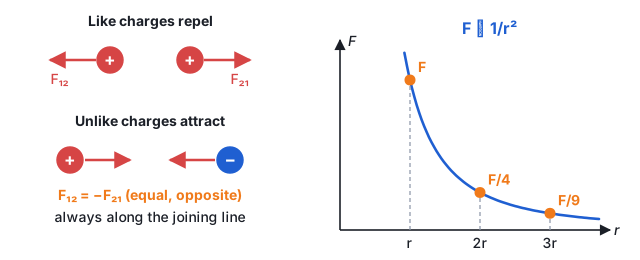
- Coulomb's law: the force between two point charges is . It acts along the line joining them, repulsive for like charges and attractive for unlike charges.
- , and , the permittivity of free space.
- Vector form: , and . The forces obey Newton's third law.
- In a medium, , where is the dielectric constant. For water .
- One coulomb is the charge that repels an equal charge 1 m away in vacuum with a force of .
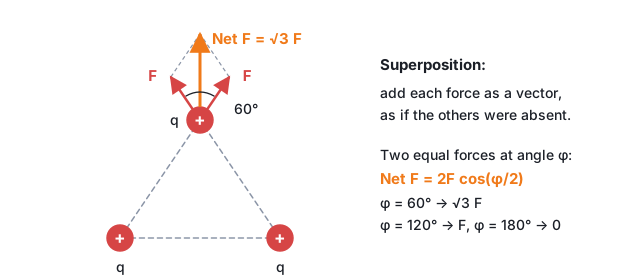
- Superposition: the net force on a charge is the vector sum of the forces from each other charge, each calculated as if the others were absent.
- The electric force between an electron and a proton is about times their gravitational attraction.
- Coulomb's law holds for point charges at rest. It is an inverse-square law, like gravitation, but the force can be attractive or repulsive.
Formulas
- ; q in C, r in m
- Vector form; force on 2 due to 1, points from 1 to 2
- , medium filling all space
- Superposition: vector sum of the forces from each charge
- Two equal forces at angle
- Null point between two LIKE charges, measured from
Tips, tricks and hacks
Common mistakes
✗ Putting the signs of the charges into the magnitude formula and calling a negative answer 'smaller'.
✓ Use magnitudes for the size; decide attract or repel from the signs.
✗ A third charge nearby changes the force between the first two.
✓ By superposition, the force between any two charges is unchanged by others; only the NET force on each changes.
✗ In a medium, .
✓ A dielectric weakens the force: , since .
✗ Using in cm and charges in C directly with .
✓ Convert to m and C first; C, cm m.
NEET traps
Two identical metal spheres that touch share their total charge equally. For example, and become each. Recompute the force using the new charges.
drops by a factor only if the medium fills all the space. A slab of thickness placed between the charges gives .
A third charge placed on the line between two charges can be in equilibrium, but its equilibrium is not always stable.
Quick check: Two identical metal spheres with charges C and C attract with force at distance . They are touched and then placed apart. The new force is
- , repulsive
- , repulsive
- , attractive
- , repulsive
Answer: A. Each gets C. , and like charges repel.
Topic 3
Electric field
A charge does not need to touch anything to push it. It fills the space around it with a field, and any charge that wanders in feels the push.
- Electric field is the force per unit positive test charge, . The test charge is made very small so that it does not disturb the source charges.
- SI unit of electric field: N/C, which is the same as V/m. It is a vector, and the force on a charge is .
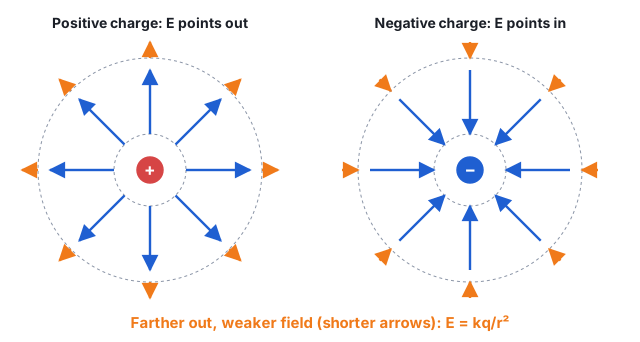
- Field of a point charge: . It points radially outward for and inward for . It has the same magnitude everywhere on a sphere around the charge.
- The field from several charges is the vector sum of the individual fields (superposition).
- The field is a physically real quantity, not just a calculation tool. In time-varying situations it carries energy and momentum, and disturbances in it travel at speed .
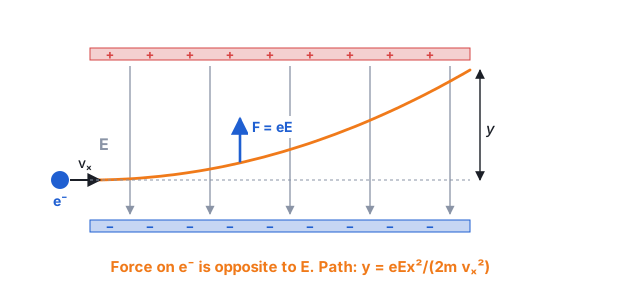
- In a uniform field , a charge accelerates with . An electron and a proton in the same field feel the same force but very different accelerations.
- An electron entering at right angles to a uniform field follows a parabolic path, like a projectile.
- NCERT example: an electron falling 1.5 cm in a field of takes much less time than a proton over the same distance, because . Gravity can be ignored.
Formulas
- Definition with a small positive test charge
- Point charge; unit N/C = V/m
- Force on any charge ; opposite to if
- Acceleration in a uniform field
- Sideways deflection after travelling across the field with speed
- Time to move from rest along the field
Tips, tricks and hacks
Common mistakes
✗ The field at a point depends on the test charge placed there.
✓ is set by the source charges; the test charge only changes the force .
✗ An electron in a field moves along .
✓ with , so the force is opposite to .
✗ Equal forces on an electron and a proton mean equal accelerations.
✓ Accelerations differ by the mass ratio, about 1836.
NEET traps
The field at a point does not depend on the test charge placed there. The force on it does.
The field at the centre of a ring or a symmetric arrangement of equal charges is zero. The potential there is generally not zero.
In the same field, an electron's acceleration is about 1836 times a proton's, because its mass is that much smaller.
Quick check: An electron and a proton are released from rest in the same uniform electric field. The ratio of their accelerations is about
- 1
- 1/1836
- 1836
Answer: C. Same force on both, and ; the electron is about 1836 times lighter.
Topic 4
Electric field lines
Faraday was not strong in mathematics, so he drew 'lines of force' instead. Those sketches became the field idea that Maxwell later turned into equations.
- Field lines are curves drawn so that the tangent at any point gives the direction of at that point.
- Field lines begin on positive charges and end on negative charges. For a single charge they start or end at infinity.
- Lines are drawn closer together where the field is strong and farther apart where it is weak. The number of lines through a unit perpendicular area is proportional to .
- In a charge-free region, field lines are continuous curves with no breaks.
- Two field lines never cross. If they did, the field would have two directions at one point.
- Electrostatic field lines do not form closed loops, because the electrostatic field is conservative.
- A uniform field is shown by parallel, equally spaced straight lines. Lines meet a conductor's surface at right angles.
- Solid angle: . The number of lines through a given solid angle stays the same with distance, which explains why .
Formulas
- Line density (lines per unit perpendicular area) measures field strength
- Solid angle; fixed lines through a fixed solid angle spread over , so
Tips, tricks and hacks
Common mistakes
✗ A charge released in a field moves along the field line.
✓ The tangent gives the force direction, not the velocity; a moving charge leaves a curved line. Only from rest in a straight-line field does it follow the line.
✗ Electrostatic field lines form closed loops, like magnetic lines.
✓ They start on and end on charges; a closed loop would mean a non-conservative field.
NEET traps
Field lines are not the path of a charged particle (except in special cases, such as a charge starting from rest in a uniform field).
Electrostatic lines never form closed loops, but magnetic field lines always do.
Field lines never cross, and they never pass through the inside of a conductor in electrostatics.
Quick check: Which statement about electrostatic field lines is WRONG?
- The tangent at a point gives the direction of
- Two field lines never intersect
- They form closed loops
- They meet a conductor's surface at right angles
Answer: C. Electrostatic lines begin on positive and end on negative charges (or infinity); they never close on themselves.
Topic 5
Electric dipole
A water molecule is a tiny dipole. That is why a charged plastic comb bends a thin stream of tap water towards itself.
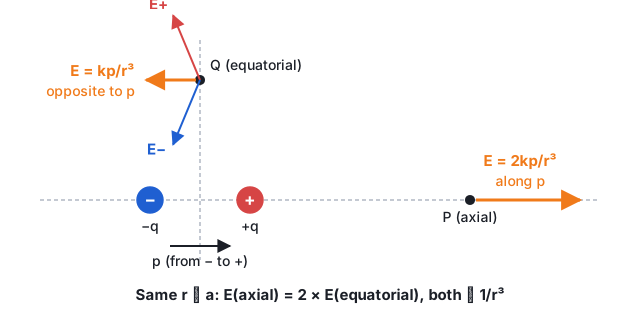
- An electric dipole is a pair of equal and opposite charges a distance apart. Its dipole moment is , pointing from to . SI unit: C m.
- Axial (end-on) field: for . It points along .
- Equatorial (broadside-on) field: . It points opposite to .
- At the same large distance, the axial field is twice the equatorial field. A dipole's field falls as , faster than a point charge's .
- Ideal (point) dipole: and while stays finite.
- Polar molecules such as and HCl have a permanent dipole moment. Non-polar molecules such as and have no permanent dipole moment, but an applied field can induce one.
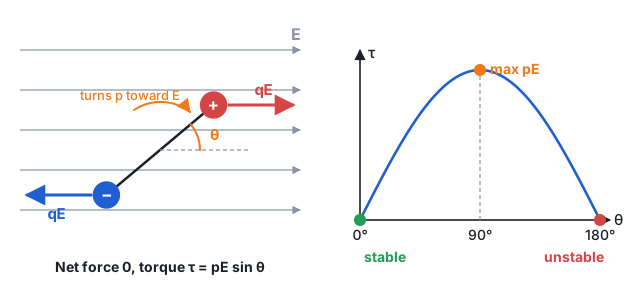
- In a uniform field the net force on a dipole is zero, but it feels a torque , with magnitude . The torque turns to line up with .
- In a non-uniform field a dipole feels a net force as well. A dipole parallel to the field is pulled towards the stronger-field region, which is why a charged comb attracts bits of paper.
Formulas
- Dipole moment in C m, from to
- Along ; approximation for
- Opposite to
- Torque in a uniform field; net force is zero
- Short dipole, general point at angle from the axis
Tips, tricks and hacks
Common mistakes
✗ points from to , like the field lines.
✓ points from to ; field lines between the charges run the other way.
✗ The equatorial field points along , or is zero.
✓ It is non-zero and points opposite to .
✗ A dipole in a uniform field moves towards the field.
✓ Net force is zero in a uniform field; it only rotates. A net force appears only in a non-uniform field.
NEET traps
In a uniform field the net force on a dipole is zero but the torque is not, unless or .
The equatorial field points opposite to . It is not zero.
The torque is maximum, , at , and zero at (stable equilibrium) and (unstable equilibrium).
Quick check: A dipole of moment C m makes with a uniform field of N/C. The torque on it is
- N m
- N m
- N m
- zero
Answer: A. N m.
Topic 6
Electric flux and Gauss's law
Hold a hoop in the rain: face it upward and many drops pass through; tilt it edge-on and none do. Electric flux works the same way, with field lines in place of raindrops.
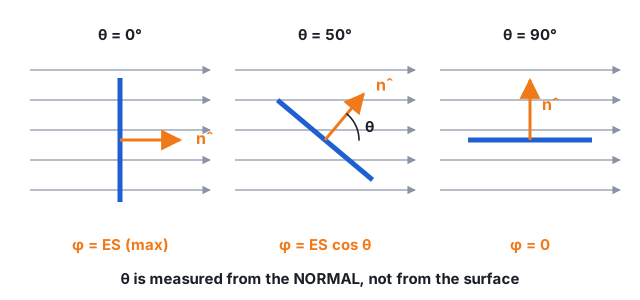
- Electric flux through a small area: . The area vector points along the normal, and outward for a closed surface.
- Flux is a scalar with unit N m²/C (equivalently V m). It is proportional to the number of field lines crossing the surface.
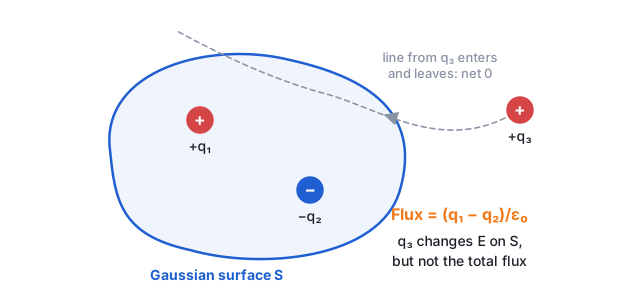
- Gauss's law: . The total flux through any closed surface depends only on the net charge inside it.
- Charges outside the Gaussian surface add zero net flux. They do contribute to at points on the surface.
- Gauss's law holds for any closed surface of any shape and size. It follows from the inverse-square nature of Coulomb's law.
- Choose the Gaussian surface to match the symmetry, so that is constant on it and perpendicular or parallel to it. The surface must not pass through a discrete point charge.
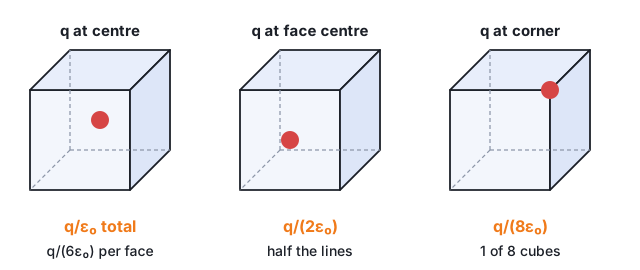
- A charge at the centre of a cube gives a flux of through the whole cube and through each face.
- A closed surface with a dipole, or with no charge, inside has zero net flux through it.
- In a uniform field, the net flux through any closed surface is zero. For example, a cylinder whose axis is along has inflow and outflow .
Formulas
- Flat area in a uniform field; from the normal
- Gauss's law; algebraic sum of enclosed charge
- Each face of a cube with at its centre
- Charge at a face centre, at a corner
- Charge in a medium of dielectric constant
- Unit N m C = V m
Tips, tricks and hacks
Common mistakes
✗ Taking as the angle between and the surface.
✓ is with the normal. If E makes with the surface, use .
✗ A charge outside the surface has no effect on the field at the surface.
✓ It does change E at each point; it only adds zero to the TOTAL flux.
✗ Moving the charge inside, or enlarging the surface, changes the flux.
✓ Total flux stays for any shape, size or position inside.
✗ Flux is a vector because it is made from vectors.
✓ It is a dot product, so a scalar (it can be negative for inward flux).
NEET traps
The total flux does not depend on the size or shape of the surface, or on where the charge sits inside it. The field at points on the surface does change.
is the angle with the NORMAL to the surface, not with the surface itself.
A charge at a cube's corner sends through the cube. A charge at the centre of a face sends through it.
Quick check: A point charge is placed at one corner of a cube. The flux through one face of the cube that does NOT touch that corner is
- 0
Answer: D. The cube gets , shared equally by its 3 far faces (the 3 touching faces get zero): each.
Topic 7
Applications of Gauss's law
Gauss's law turns pages of integration into one line, but only when the charge has symmetry: a long wire, a big flat sheet or a sphere.
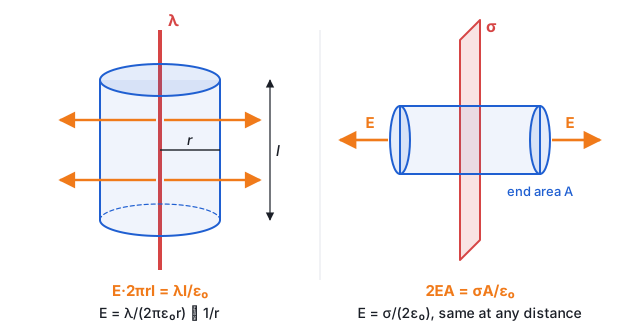
- Infinitely long straight wire with linear charge density : use a cylindrical Gaussian surface. , directed radially, so .
- Infinite plane sheet with surface charge density : use a pillbox (cylinder) through the sheet. , the same at every distance and normal to the sheet.
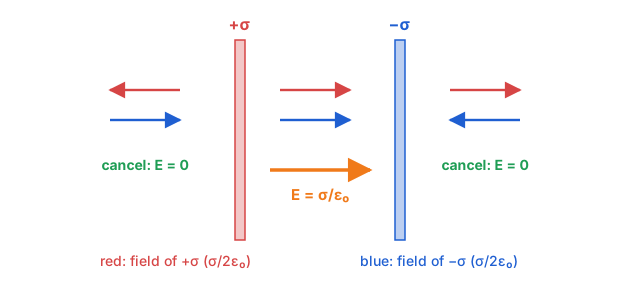
- Two parallel sheets with and : the field between them is and the field outside is zero. This is the field in a parallel plate capacitor.
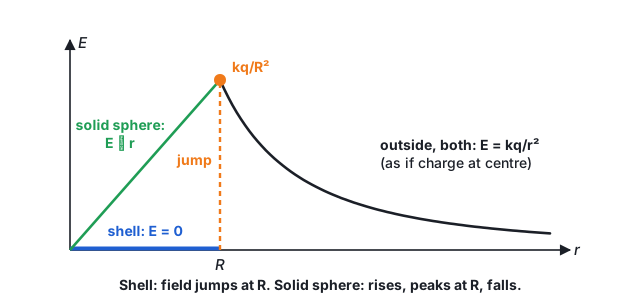
- Thin spherical shell of charge and radius : outside () the field is , as if all the charge were at the centre. Inside () the field is .
- Just outside the shell, , where . The field jumps from 0 to this value as you cross the shell.
- Uniformly charged solid sphere (a non-conductor): inside, , which increases linearly with . Outside it follows the point-charge law.
- Outside a charged conductor, , normal to the surface. Inside the conductor's material, .
- These results work only because of symmetry: infinite length, infinite area, or spherical symmetry. For a finite wire or sheet they are only approximations near the middle.
Formulas
- Infinite line charge. lambda is in C/m.
- Infinite thin sheet of charge, independent of distance. sigma is in C/m^2.
- Thin spherical shell of charge.
- Just outside a charged conductor, or between oppositely charged parallel plates.
- Inside a uniformly charged solid (non-conducting) sphere.
Tips, tricks and hacks
Common mistakes
✗ Using for an isolated thin sheet of charge.
✓ A thin sheet sends flux both ways: .
✗ Field inside a charged shell is zero, so potential inside is zero too.
✓ Potential inside is constant at ; only its slope (the field) is zero.
✗ Line charge field falls as .
✓ The cylinder's area grows as , so .
✗ Gauss's law is not valid for a cube of charge or a finite wire.
✓ The law is always true; it just does not give E easily without symmetry.
NEET traps
A thin sheet of charge gives , but just outside a conductor the field is . Do not mix the two.
Inside a charged shell , but the potential there is not zero. It is constant and equal to .
For a line charge . For a point charge . For a sheet, does not depend on .
Quick check: An infinitely long line charge produces a field of N/C at 2 cm from it. The field at 6 cm is
- N/C
- N/C
- N/C
- N/C
Answer: B. : distance triples, so N/C.
Quick revision: Electric Charges and Fields the night before NEET
- , C; charge is additive, conserved, quantised and invariant.
- Charging by rubbing or induction only moves electrons; in induction the rod loses no charge.
- Identical conductors that touch share the total charge equally: each.
- , N m C; in a medium .
- Two equal forces at angle : ; equilateral triangle of charges gives .
- in N/C = V/m; force on an electron is opposite to .
- Same field: .
- Field lines: start on , end on , never cross, never form closed loops, meet conductors at .
- from to ; along , opposite to .
- ; net force zero in a uniform field; stable, unstable.
- with from the normal; unit N m/C = V m.
- Gauss: ; outside charges add zero net flux.
- Cube: centre per face; face centre ; corner total.
- Line ; sheet ; conductor or between plates .
- Shell: inside, outside; solid sphere inside .
Practise Electric Charges and Fields questions
Topic-wise practice from Level 1 to Level 3, NCERT-based questions and NEET PYQs, with a full solution after every answer.
Start practising free