Class 11 Physics · NCERT notes for NEET
Waves: NCERT Notes, Formulas and Tricks for NEET
Travelling waves, the speed of string waves and sound, superposition, standing waves on strings and in pipes, and beats. NEET usually asks a question from here, most often on harmonics of strings and pipes, wave equations or beats.
- 1. Wave motion and speed of waves
- 2. Superposition and standing waves 🔒
- 3. Strings and organ pipes 🔒
- 4. Beats 🔒
Topic 1 is open for everyone. The full chapter, quick revision and practice open with a plan, or start free with 5 full chapters.
Open the interactive version (simulations and tap-to-answer quick checks).
Topic 1
Wave motion and speed of waves
In a stadium Mexican wave the 'wave' runs around the whole ground, yet every fan just stands up and sits down in their own seat. That is exactly how a wave carries energy without carrying matter.
- A wave is a travelling pattern of disturbance. It carries energy and information, but the medium as a whole does not travel; each particle only oscillates about its mean position.
- Mechanical waves need a medium and depend on its elasticity and inertia (string waves, sound). Electromagnetic waves need no medium and all travel at in vacuum. Matter waves go with moving electrons, protons, atoms.
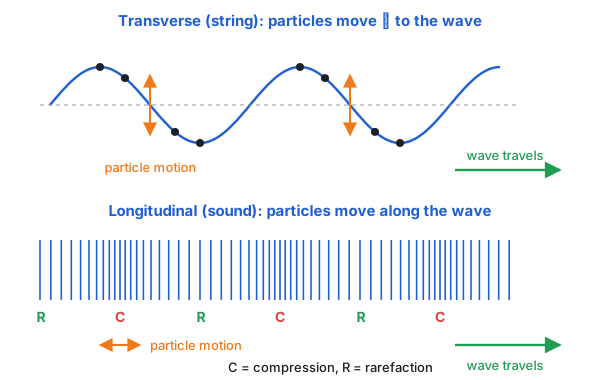
- Transverse: particles move perpendicular to the direction of travel (string). Needs shear rigidity, so mechanical transverse waves travel in solids, not through the bulk of fluids.
- Longitudinal: particles move along the direction of travel, forming compressions and rarefactions (sound). These can travel in solids, liquids and gases.
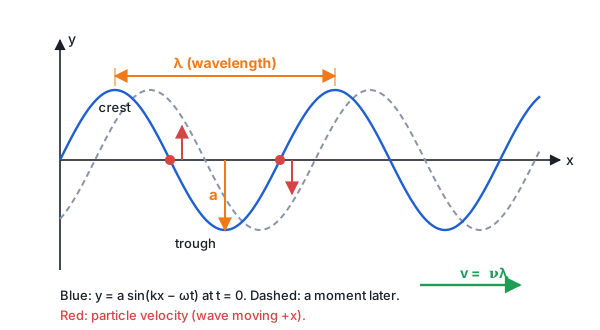
- Progressive wave: moves along ; means it moves along . If , the amplitude is .
- Wavelength : least distance between two points in the same phase. (rad m), , .
- Wave speed . The medium fixes ; the source fixes .
- String: ( = mass per unit length). It does not depend on or .
- Sound: in a fluid, in a solid rod. Usually .
- Newton (isothermal): in air at STP, too low. Laplace (adiabatic): with . In a gas : , independent of pressure.
Formulas
- Wave along ; amplitude, angular wave number, angular frequency
- Wave speed in m/s
- String: tension (N), mass per length (kg/m)
- Sound in a gas (Laplace); in kg/mol
- Fluid (bulk modulus) and solid rod (Young's modulus)
- Phase difference between two points apart
- Maximum particle speed (not the wave speed)
Tips, tricks and hacks
Common mistakes
✗ When sound goes from air into water its frequency changes.
✓ Frequency is fixed by the source and stays the same; and change together.
✗ Higher pressure makes sound travel faster in air.
✓ stays constant at fixed , so pressure has no effect; only (and humidity) matter.
✗ Particle speed equals wave speed .
✓ Particle velocity is , maximum ; wave speed is . They are different things.
✗ Doubling the tension doubles the wave speed on a string.
✓ , so it rises by .
NEET traps
NEET may write : this also moves along (same as ). The sign between the terms decides direction, not which term comes first.
'Sound travels faster in humid air' is TRUE: moist air is less dense than dry air at the same and .
Newton used isothermal modulus ; Laplace used adiabatic . An option with is Newton's (wrong) value.
Quick check: A wave is in SI units. Its speed and direction are
- 5 m/s along −x
- 20 m/s along +x
- 20 m/s along −x
- 5 m/s along +x
Answer: B. , , so m/s. Terms and have opposite signs, so it moves along .
Topic 2 · 🔒
Superposition and standing waves
Key points, graphs, every formula, tricks, common mistakes and NEET traps for this topic are inside Dhruv.
Start freeTopic 3 · 🔒
Strings and organ pipes
Key points, graphs, every formula, tricks, common mistakes and NEET traps for this topic are inside Dhruv.
Start freeTopic 4 · 🔒
Beats
Key points, graphs, every formula, tricks, common mistakes and NEET traps for this topic are inside Dhruv.
Start freePractise Waves questions
Topic-wise practice from Level 1 to Level 3, NCERT-based questions and NEET PYQs, with a full solution after every answer.
Start practising free