Class 11 Physics · NCERT notes for NEET
Oscillations: NCERT Notes, Formulas and Tricks for NEET
Periodic motion, simple harmonic motion (SHM), the energy of an oscillator, and the spring and pendulum systems. NEET usually asks a direct question from here (a time period, a speed at some x, or an energy ratio), and the same ideas carry straight into Waves.
Topic 1 is open for everyone. The full chapter, quick revision and practice open with a plan, or start free with 5 full chapters.
Open the interactive version (simulations and tap-to-answer quick checks).
Topic 1
Simple harmonic motion
A swing, a guitar string, the needle of a sewing machine and the atoms in a crystal all obey one equation: .
- Periodic motion repeats after a fixed time. Oscillatory motion is a to-and-fro motion about a mean (equilibrium) position.
- Every oscillatory motion is periodic, but not every periodic motion is oscillatory. Uniform circular motion and planetary orbits are periodic but not oscillatory.
- Period is the smallest time after which the motion repeats. Frequency (unit hertz, ). Angular frequency in rad/s.
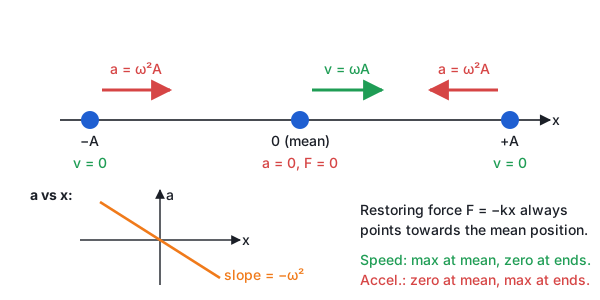
- SHM: the restoring force is proportional to the displacement and always points towards the mean position, . Then with .
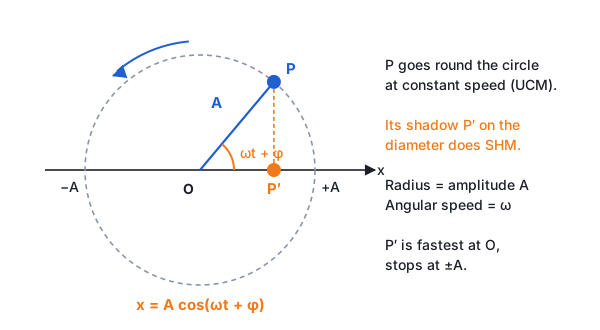
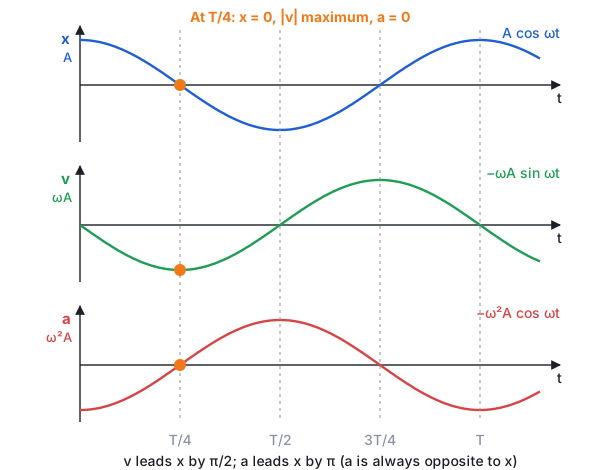
- Displacement . is the amplitude, is the phase and is the phase constant. and are fixed by the initial position and velocity.
- with and . It is still SHM with the same period. Any periodic function can be built from sines and cosines of different periods.
- SHM is the projection of uniform circular motion on any diameter of the reference circle. Radius = , angular speed = .
- Velocity , so : maximum at the mean, zero at the extremes.
- Acceleration : maximum at the extremes, zero at the mean. Velocity leads by ; acceleration leads by .
- The period does not depend on the amplitude (isochronous). In one period the particle travels .
Formulas
- Displacement in SHM
- Angular frequency in rad/s
- Speed at displacement
- Defining condition of SHM
- Restoring force; in N/m
- Amplitude from initial position and velocity
- The - graph of SHM is an ellipse
Tips, tricks and hacks
Common mistakes
✗ Velocity and acceleration are both maximum at the same point.
✓ Speed is maximum at the mean (); acceleration is maximum at the extremes. They are out of phase.
✗ A bigger swing (larger ) takes more time.
✓ In SHM does not contain . Larger just means larger .
✗ Every periodic motion, like uniform circular motion, is SHM.
✓ SHM needs to-and-fro motion with . Circular motion is periodic, not oscillatory; only its projection is SHM.
✗ In time from the mean, the particle covers .
✓ Motion is not uniform. In (phase ) it covers starting from the mean.
NEET traps
repeats with period , not . NEET 2018's answer: it is periodic, but not SHM (its acceleration is not about ).
is periodic but NOT SHM; IS SHM with amplitude . is not periodic at all.
Phase difference between displacement and acceleration is (not ); between velocity and acceleration it is .
Quick check: A particle in SHM has amplitude 10 cm and maximum speed 2 m/s. Its speed when it is 6 cm from the mean position is
- 1.2 m/s
- 1.6 m/s
- 0.8 m/s
- 1.8 m/s
Answer: B. rad/s, so m/s.
Topic 2 · 🔒
Energy in SHM
Key points, graphs, every formula, tricks, common mistakes and NEET traps for this topic are inside Dhruv.
Start freeTopic 3 · 🔒
Spring and pendulum systems
Key points, graphs, every formula, tricks, common mistakes and NEET traps for this topic are inside Dhruv.
Start freePractise Oscillations questions
Topic-wise practice from Level 1 to Level 3, NCERT-based questions and NEET PYQs, with a full solution after every answer.
Start practising free