Class 11 Physics · NCERT notes for NEET
Kinetic Theory: NCERT Notes, Formulas and Tricks for NEET
Kinetic theory explains pressure, temperature and specific heats from the random motion of molecules. It is a short, formula-rich chapter; NEET usually has about one question from it, often on , degrees of freedom or .
- 1. Ideal gas equation
- 2. Kinetic interpretation of pressure and temperature 🔒
- 3. Degrees of freedom and equipartition 🔒
- 4. Mean free path 🔒
Topic 1 is open for everyone. The full chapter, quick revision and practice open with a plan, or start free with 5 full chapters.
Open the interactive version (simulations and tap-to-answer quick checks).
Topic 1
Ideal gas equation
A pressure cooker, a bicycle pump and a weather balloon all follow one line of physics: .
- Gas molecules are far apart (about 10 times their size of 2 Å) and move freely; in solids and liquids they are close, so intermolecular forces (attraction at a few Å, repulsion closer) matter.
- At low pressure and high temperature (far above liquefaction) every gas obeys , with (Boltzmann constant), same for all gases.
- Avogadro: equal volumes of all gases at the same and contain equal numbers of molecules. 1 mole molecules and occupies 22.4 L at STP (273 K, 1 atm).
- Ideal gas equation: , with and (mass / molar mass).
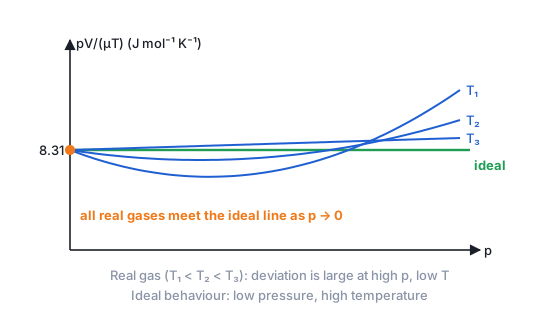
- An ideal gas obeys exactly at all and . Real gases come close only at low and high ; all curves of meet as .
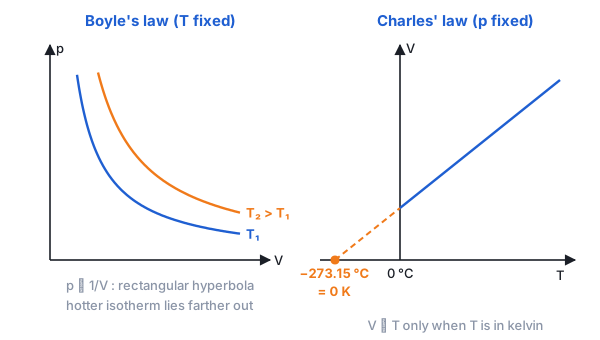
- Boyle's law: fixed, = constant (p-V graph is a rectangular hyperbola). Charles' law: fixed, (T in kelvin).
- Density form: . At fixed and , density is proportional to molar mass.
- Dalton's law: for non-reacting ideal gases in one vessel, .
- Graham's law: rate of diffusion ; this is how is separated from (as ).
Formulas
- = moles, = molecules, in kelvin
- Universal gas constant
- = density, = molar mass in kg/mol
- Dalton's law of partial pressures
- Graham's law of diffusion
Tips, tricks and hacks
Common mistakes
✗ Putting temperature in C in or in Charles' law.
✓ Always use kelvin; holds only on the absolute scale.
✗ Taking molar mass of as 32 in with SI units.
✓ In SI, ; otherwise the answer is off by 1000.
✗ Real gases behave ideally at high pressure and low temperature.
✓ It is the reverse: low , high , where molecules are far apart and forces are negligible.
NEET traps
22.4 L per mole is true only at STP; at 300 K and 1 atm one mole occupies about 24.6 L.
" depends on the gas" is false: and are universal constants.
In a p-V graph two isotherms never cross; the one farther from the origin is at higher .
Quick check: A gas in a closed vessel has its absolute temperature doubled and its volume reduced to one-third. The pressure becomes
- 2/3 times
- 3/2 times
- 6 times
- 1/6 times
Answer: C. , so .
Topic 2 · 🔒
Kinetic interpretation of pressure and temperature
Key points, graphs, every formula, tricks, common mistakes and NEET traps for this topic are inside Dhruv.
Start freeTopic 3 · 🔒
Degrees of freedom and equipartition
Key points, graphs, every formula, tricks, common mistakes and NEET traps for this topic are inside Dhruv.
Start freeTopic 4 · 🔒
Mean free path
Key points, graphs, every formula, tricks, common mistakes and NEET traps for this topic are inside Dhruv.
Start freePractise Kinetic Theory questions
Topic-wise practice from Level 1 to Level 3, NCERT-based questions and NEET PYQs, with a full solution after every answer.
Start practising free