Class 11 Physics · NCERT notes for NEET
Thermodynamics: NCERT Notes, Formulas and Tricks for NEET
How heat, work and internal energy are linked: the zeroth, first and second laws, the four standard processes on a p-V graph, and reversible and irreversible processes. NEET asks from this chapter almost every year, mostly p-V graphs and first-law sign problems.
- 1. Zeroth and first law of thermodynamics
- 2. Thermodynamic processes 🔒
- 3. Second law of thermodynamics 🔒
Topic 1 is open for everyone. The full chapter, quick revision and practice open with a plan, or start free with 5 full chapters.
Open the interactive version (simulations and tap-to-answer quick checks).
Topic 1
Zeroth and first law of thermodynamics
Rub your palms and they get warm with no flame at all: work alone can raise internal energy, exactly as heat does.
- Thermodynamics studies heat, temperature and the conversion of heat into other forms of energy using macroscopic variables like , , (not individual molecules).
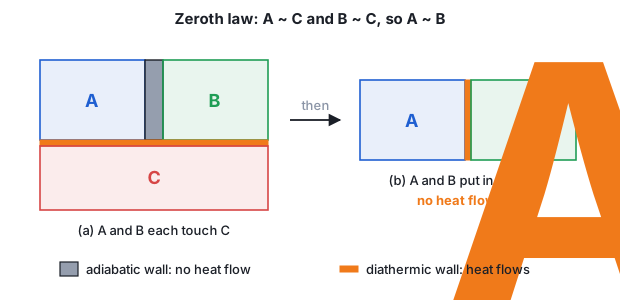
- Thermal equilibrium: the macroscopic variables of the system do not change with time. An adiabatic wall blocks heat flow; a diathermic (conducting) wall allows it.
- Zeroth law: if A and B are each in thermal equilibrium with C, then A and B are in thermal equilibrium with each other. It gives us the idea of temperature: bodies in equilibrium have the same .
- Internal energy = sum of kinetic and potential energies of the random (disordered) motion of molecules, measured in the centre-of-mass frame. The KE of the whole container moving is NOT part of .
- is a state variable: depends only on the initial and final states. For an ideal gas, depends only on .
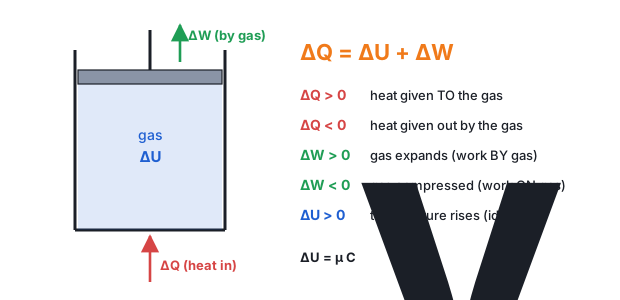
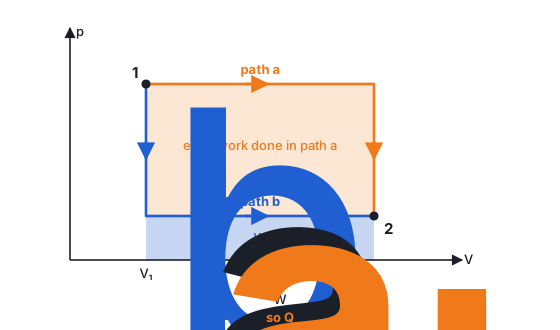
- Heat is energy transfer because of a temperature difference; work is energy transfer by any other means (moving piston, stirring). Neither is a state variable: both depend on the path.
- First law (energy conservation): , with for heat given to the system and for work done by the system.
- Work done by a gas = area under the - curve.
- Specific heat (J kg K); molar specific heat . For water J kg K; cal J.
- For an ideal gas and . Extensive variables (, , mass) scale with size; intensive ones (, , density) do not.
Formulas
- First law; is work done BY the system
- Work by gas = area under - curve
- Ideal gas, valid for ANY process
- Mayer's relation (molar, ideal gas)
- = degrees of freedom: monatomic, rigid diatomic
- Heat for a temperature change
Tips, tricks and hacks
Common mistakes
✗ Work done on the gas is positive in .
✓ In NCERT's form is work BY the gas; compression makes it negative.
✗ only at constant volume.
✓ is a state function of for an ideal gas, so it holds for every process.
✗ A moving container of gas has more internal energy.
✓ Bulk KE of the container is ordered motion; counts only random motion in the CM frame.
✗ Heat and temperature mean the same thing.
✓ Temperature is a state property; heat is energy in transit because of a temperature difference.
NEET traps
"Heat and work are state variables" is FALSE; only (with , , ) is. NEET often pairs this with a true statement about being path independent.
The zeroth law defines temperature (thermal equilibrium). It is the first law that is energy conservation; options swap them.
Heat supplied is extensive ( doubles if the system doubles); temperature and pressure are intensive.
Quick check: A gas is compressed: 300 J of work is done on it and it gives out 100 J of heat. The change in its internal energy is
- J
- J
- J
- J
Answer: B. J, J, so J.
Topic 2 · 🔒
Thermodynamic processes
Key points, graphs, every formula, tricks, common mistakes and NEET traps for this topic are inside Dhruv.
Start freeTopic 3 · 🔒
Second law of thermodynamics
Key points, graphs, every formula, tricks, common mistakes and NEET traps for this topic are inside Dhruv.
Start freePractise Thermodynamics questions
Topic-wise practice from Level 1 to Level 3, NCERT-based questions and NEET PYQs, with a full solution after every answer.
Start practising free