Class 11 Physics · NCERT notes for NEET
Thermal Properties of Matter: NCERT Notes, Formulas and Tricks for NEET
Temperature scales, thermal expansion, specific heat, latent heat and the three modes of heat transfer. NEET usually asks one or two questions from here, mostly on calorimetry, expansion and conduction.
- 1. Temperature, scales and thermal expansion
- 2. Specific heat, calorimetry and change of state 🔒
- 3. Heat transfer: conduction, convection, radiation 🔒
Topic 1 is open for everyone. The full chapter, quick revision and practice open with a plan, or start free with 5 full chapters.
Open the interactive version (simulations and tap-to-answer quick checks).
Topic 1
Temperature, scales and thermal expansion
Railway tracks have small gaps and power lines sag more in May than in January: both are just at work.
- Temperature tells how hot or cold a body is. Heat is energy that flows only because of a temperature difference. Heat is measured in joule; temperature in kelvin (K) or .
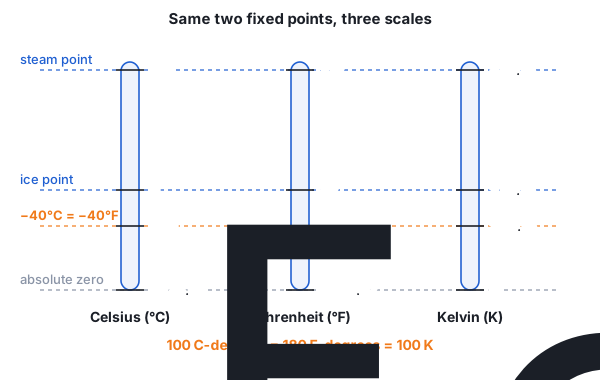
- Fixed points at 1 atm: ice point and steam point. Celsius 0 and 100, Fahrenheit 32 and 212, Kelvin 273.15 and 373.15.
- Conversion: and . A kelvin and a Celsius degree are the same size; difference difference.
- Ideal gas: , . A constant-volume gas thermometer extrapolates at : absolute zero.
- Linear, area and volume expansion: , , for an isotropic solid.
- Metals have large (copper, aluminium); glass and invar have small . Liquids and gases are described by only.
- Ideal gas at constant pressure: . At this is , far larger than for solids and liquids.
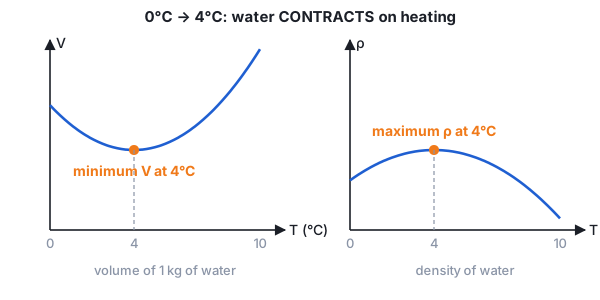
- Anomalous expansion: water contracts from to , so it is densest at . Lakes freeze from the top down and fish survive in the water below.
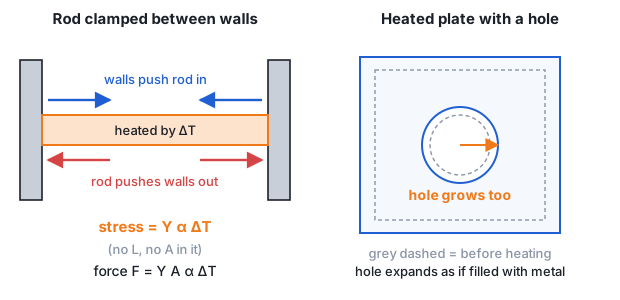
- A rod clamped at both ends and heated cannot expand: thermal stress (compressive), thermal force .
- A hole or cavity expands on heating exactly as if it were filled with the same material.
Formulas
- Fahrenheit-Celsius conversion
- Kelvin from Celsius
- Linear expansion; in
- Area and volume expansion of an isotropic solid
- Ideal gas at constant pressure ( in kelvin)
- Clamped rod: thermal stress and thermal force
Tips, tricks and hacks
Common mistakes
✗ A hole in a metal plate shrinks on heating because the metal expands into it.
✓ Every length in the plate, including the hole's diameter, scales by , so the hole grows.
✗ Thermal stress in a clamped rod is larger for a longer rod.
✓ Stress has no or ; only the force depends on area.
✗ Using for a temperature change.
✓ The 32 shifts readings, not differences: .
✗ Water is densest at (ice point).
✓ Water is densest at ; ice is even less dense than water, which is why it floats.
NEET traps
"Water expands on heating at all temperatures": FALSE; it contracts from to .
needs in kelvin: at it is , not .
A question gives and asks the change in volume of a hollow sphere: the cavity expands like solid metal, so use on the outer volume.
Quick check: A metal plate has . If it is heated through 50 K, the percentage increase in its area is
- 0.1%
- 0.2%
- 0.3%
- 0.02%
Answer: B. .
Topic 2 · 🔒
Specific heat, calorimetry and change of state
Key points, graphs, every formula, tricks, common mistakes and NEET traps for this topic are inside Dhruv.
Start freeTopic 3 · 🔒
Heat transfer: conduction, convection, radiation
Key points, graphs, every formula, tricks, common mistakes and NEET traps for this topic are inside Dhruv.
Start freePractise Thermal Properties of Matter questions
Topic-wise practice from Level 1 to Level 3, NCERT-based questions and NEET PYQs, with a full solution after every answer.
Start practising free