Class 11 Physics · NCERT notes for NEET
Mechanical Properties of Fluids: NCERT Notes, Formulas and Tricks for NEET
How fluids push, flow and stick: pressure and buoyancy, continuity and Bernoulli, viscosity and terminal velocity, surface tension and capillary rise. NEET regularly asks from it, most often on terminal velocity, Bernoulli or continuity, excess pressure and capillary rise.
- 1. Pressure and Pascal's law
- 2. Streamline flow and Bernoulli's principle 🔒
- 3. Viscosity and Stokes' law 🔒
- 4. Surface tension and capillarity 🔒
Topic 1 is open for everyone. The full chapter, quick revision and practice open with a plan, or start free with 5 full chapters.
Open the interactive version (simulations and tap-to-answer quick checks).
Topic 1
Pressure and Pascal's law
A dam wall is much thicker at the bottom than at the top: water pressure grows with depth, not with how much water is stored behind it.
- Fluids (liquids and gases) can flow. A fluid at rest cannot hold a shear force, so it pushes only normal (perpendicular) to any surface it touches.
- Pressure (normal force per unit area). It is a scalar; SI unit pascal, . Density , unit (water , mercury ).
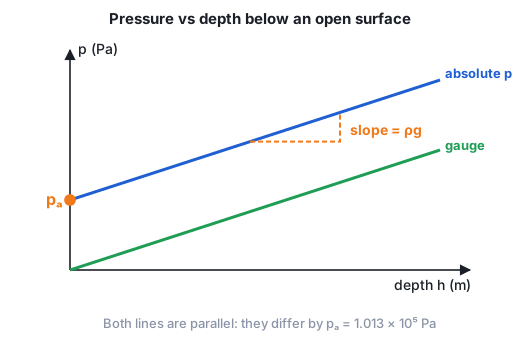
- At depth below an open surface: . The excess is the gauge pressure.
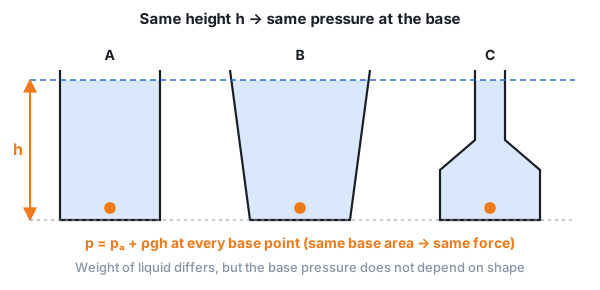
- Pressure depends only on depth, not on the shape or base area of the vessel (hydrostatic paradox). Points at the same level in a connected liquid at rest have equal pressure.
- Atmospheric pressure = weight of the air column of unit area above the point. A mercury barometer at sea level stands at about 76 cm: .
- Other units: , . An open-tube manometer measures pressure differences (gauge pressure).
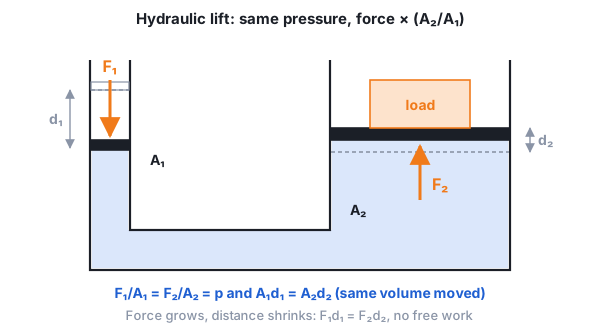
- Pascal's law: a change in pressure applied to an enclosed fluid at rest is transmitted undiminished to every part of the fluid and to the walls.
- Hydraulic lift and hydraulic brakes use Pascal's law. Force is multiplied by , but the big piston moves less (), so work is not multiplied.
- Archimedes' principle: a body fully or partly immersed in a fluid gets an upward buoyant force equal to the weight of the fluid it displaces, so it appears lighter.
- Floating body: weight = buoyant force, so fraction submerged .
Formulas
- Normal force over area; unit Pa
- Absolute pressure at depth below an open surface; gauge pressure
- Hydraulic lift: equal pressure, equal volume displaced
- Buoyant force; = fluid density, = displaced volume
- Floating body of density in fluid of density
Tips, tricks and hacks
Common mistakes
✗ A wider or bigger vessel has more pressure at the bottom because it holds more liquid.
✓ Pressure at the base depends only on depth: . Shape and volume do not matter.
✗ Using when the question asks for total (absolute) pressure.
✓ Absolute ; gauge . Read which one is asked.
✗ A hydraulic lift gives more work out than you put in.
✓ It multiplies force only. : the big piston rises a small distance.
✗ A heavier (denser) body gets a bigger buoyant force.
✓ Buoyant force depends only on the displaced volume and the fluid density: . Equal-volume iron and aluminium balls, fully dipped, get equal buoyancy.
NEET traps
Pressure is a scalar even though force is a vector: at a point in a fluid at rest it acts equally in all directions.
Hydrostatic paradox: vessels of different shapes, same height and base area, have the same force on the base even though the liquid weights differ. Options that say "the heavier vessel has more base pressure" are wrong.
A body floating in water: if it is moved to a denser liquid (salt water), it floats higher, but the buoyant force stays equal to its weight.
Quick check: In a hydraulic lift the small piston has area 2 cm² and the large piston 200 cm². What force on the small piston holds up a 1000 kg car? (g = 10 m s⁻²)
- 10 N
- 100 N
- 1000 N
- 10⁴ N
Answer: B. N.
Topic 2 · 🔒
Streamline flow and Bernoulli's principle
Key points, graphs, every formula, tricks, common mistakes and NEET traps for this topic are inside Dhruv.
Start freeTopic 3 · 🔒
Viscosity and Stokes' law
Key points, graphs, every formula, tricks, common mistakes and NEET traps for this topic are inside Dhruv.
Start freeTopic 4 · 🔒
Surface tension and capillarity
Key points, graphs, every formula, tricks, common mistakes and NEET traps for this topic are inside Dhruv.
Start freePractise Mechanical Properties of Fluids questions
Topic-wise practice from Level 1 to Level 3, NCERT-based questions and NEET PYQs, with a full solution after every answer.
Start practising free