Class 11 Physics · NCERT notes for NEET
Mechanical Properties of Solids: NCERT Notes, Formulas and Tricks for NEET
How solids stretch, shear and squeeze under forces: stress, strain, Hooke's law, the stress-strain curve, the three elastic moduli and stored elastic energy. It is a short chapter; NEET usually asks one formula-based question from it, often a Young's modulus ratio for wires.
Topic 1 is open for everyone. The full chapter, quick revision and practice open with a plan, or start free with 5 full chapters.
Open the interactive version (simulations and tap-to-answer quick checks).
Topic 1
Stress, strain and Hooke's law
A steel rod only 2 cm thick can hold up about 30 tonnes, yet stretches by less than a millimetre per metre. Stress and strain tell you why.
- Elasticity: a body regains its original size and shape when the deforming force is removed. Plasticity: it stays permanently deformed (putty, mud). No real material is perfectly elastic or perfectly plastic.
- Atomic picture: atoms sit in stable equilibrium under interatomic forces. Deforming the body changes their spacing, and these forces pull them back, giving the restoring force.
- Stress = restoring force per unit area, . SI unit = pascal (Pa), dimensions , same as pressure.
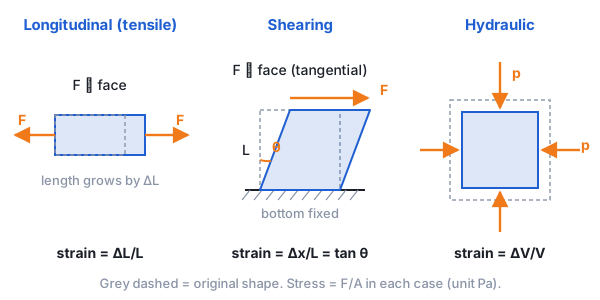
- Three kinds of stress: longitudinal (tensile or compressive, force normal to the face), shearing (force tangential to the face) and hydraulic (equal normal pressure from all sides).
- Strain = change in dimension / original dimension, so it has no unit and no dimensions. Longitudinal , shear , volume .
- Hooke's law: for small deformations stress strain, i.e. stress strain, where is the modulus of elasticity.
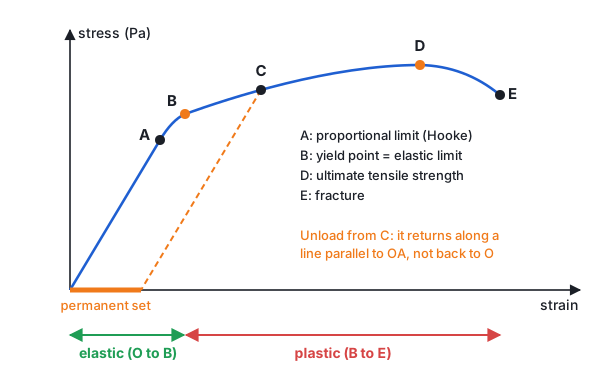
- Stress-strain curve of a metal: straight up to the proportional limit A (Hooke's law region); the body still recovers fully up to the yield point B (elastic limit), whose stress is the yield strength .
- Beyond B the strain rises fast for little extra stress. Unloaded at C, the wire does not return to zero: the leftover strain is the permanent set (plastic deformation).
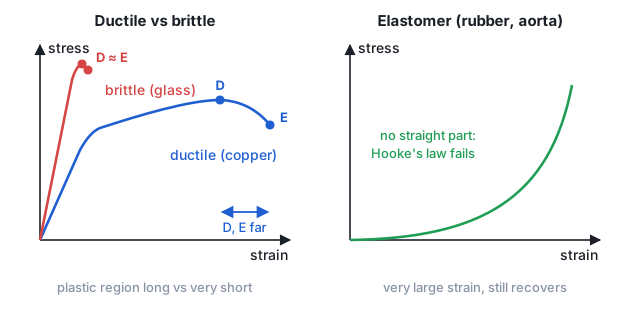
- D is the ultimate tensile strength (maximum stress); after D the wire thins and breaks at E (fracture). Ductile: D and E far apart (copper, aluminium). Brittle: D and E close (glass, cast iron).
- Elastomers such as rubber and the elastic tissue of the aorta stretch to huge strains and still recover, but their curve has no straight part, so Hooke's law does not hold.
Formulas
- Stress; Pa,
- Longitudinal (tensile or compressive) strain
- in radians, small angle
- Under hydraulic stress
- Hooke's law, valid only in the linear region
Tips, tricks and hacks
Common mistakes
✗ Rubber is more elastic than steel because it stretches more.
✓ Steel needs a far larger stress for the same strain (much larger modulus) and recovers better, so steel is more elastic.
✗ Elastic limit and proportional limit are the same point.
✓ Proportional limit A comes first; between A and B the body still recovers but stress is not proportional to strain.
✗ A thicker wire has a larger breaking stress.
✓ Breaking stress is a material property; a thicker wire has a larger breaking force (), not a larger breaking stress.
NEET traps
"Hooke's law holds up to the elastic limit" looks right but NCERT says up to the proportional limit (the linear part).
Strain has no unit, but shear strain is an angle in radians; NEET may give in degrees and expect you to convert.
Stress is the internal restoring force per area; it has the same unit as pressure but is not a vector, so do not add stresses like vectors.
Quick check: A rod of radius 1 cm carries a tensile force of N. The stress in the rod is
- Pa
- Pa
- Pa
- Pa
Answer: A. , so Pa.
Topic 2 · 🔒
Elastic moduli
Key points, graphs, every formula, tricks, common mistakes and NEET traps for this topic are inside Dhruv.
Start freeTopic 3 · 🔒
Elastic potential energy
Key points, graphs, every formula, tricks, common mistakes and NEET traps for this topic are inside Dhruv.
Start freePractise Mechanical Properties of Solids questions
Topic-wise practice from Level 1 to Level 3, NCERT-based questions and NEET PYQs, with a full solution after every answer.
Start practising free