Class 11 Physics · NCERT notes for NEET
Gravitation: NCERT Notes, Formulas and Tricks for NEET
Newton's law of gravitation, how g changes with height and depth, gravitational potential energy, escape and orbital speed, satellites and Kepler's laws. NEET almost always asks something from this chapter, mostly short formula-and-ratio questions.
- 1. Newton's law of gravitation
- 2. Acceleration due to gravity and its variation 🔒
- 3. Gravitational potential and potential energy 🔒
- 4. Escape speed and orbital velocity 🔒
- 5. Satellites and Kepler's laws 🔒
Topic 1 is open for everyone. The full chapter, quick revision and practice open with a plan, or start free with 5 full chapters.
Open the interactive version (simulations and tap-to-answer quick checks).
Topic 1
Newton's law of gravitation
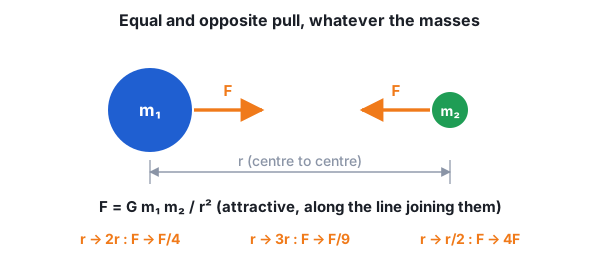
The Earth pulls an apple with the same force that the apple pulls the Earth. The apple moves because its mass is tiny, not because its pull is weaker.
- Every two point masses attract each other with a force product of the masses and : .
- is universal: same everywhere, any medium. Dimensions . Cavendish first measured it (torsion balance, 1798).
- The force is always attractive and acts along the line joining the two centres (a central force). It is conservative and the weakest of the fundamental forces.
- Newton's third law holds: . The forces are equal even if ; the accelerations are not.
- Vector form: force on by is , where points from to (the minus sign shows attraction).
- Superposition: the net force on a mass is the vector sum of the forces from every other mass, each found as if the others were absent.
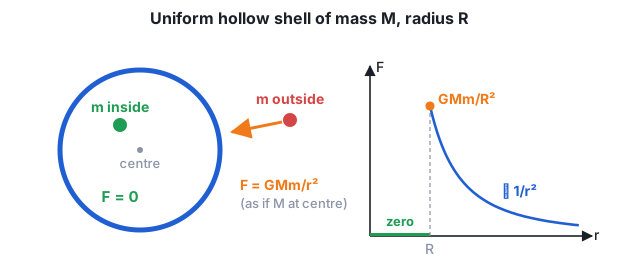
- Shell theorem: a uniform shell attracts an outside mass as if all its mass were at its centre; on a mass inside the shell, the force is zero.
- A uniform solid sphere is a set of shells, so outside it you can treat it as a point mass at its centre ( = centre-to-centre distance).
- NCERT example: equal masses at the corners of an equilateral triangle give zero net force on a mass at the centroid (symmetry).
Formulas
- Point masses or spheres; between centres
- Vector form; force on due to
- Superposition for many masses
- From
Tips, tricks and hacks
Common mistakes
✗ The heavier body pulls the lighter one with a larger force.
✓ By Newton's third law the two forces are always equal in size; only the accelerations differ.
✗ Using the surface-to-surface gap as for two spheres.
✓ For spheres, is the distance between centres (shell theorem).
✗ Gravity becomes weaker if a wall or water lies between the bodies.
✓ Gravitational force does not depend on the medium; is the same everywhere.
NEET traps
is a universal constant; changes with place. Options that say " decreases with height" are wrong.
Inside a uniform shell the force (and field) is zero, but the potential is not zero; it is constant at .
The law applies directly to point masses and spherically symmetric bodies, not to a rod or a disc.
Quick check: Two spheres attract each other with force . If the mass of each is doubled and the distance between their centres is also doubled, the new force is
Answer: C. : factor , so the force is unchanged.
Topic 2 · 🔒
Acceleration due to gravity and its variation
Key points, graphs, every formula, tricks, common mistakes and NEET traps for this topic are inside Dhruv.
Start freeTopic 3 · 🔒
Gravitational potential and potential energy
Key points, graphs, every formula, tricks, common mistakes and NEET traps for this topic are inside Dhruv.
Start freeTopic 4 · 🔒
Escape speed and orbital velocity
Key points, graphs, every formula, tricks, common mistakes and NEET traps for this topic are inside Dhruv.
Start freeTopic 5 · 🔒
Satellites and Kepler's laws
Key points, graphs, every formula, tricks, common mistakes and NEET traps for this topic are inside Dhruv.
Start freePractise Gravitation questions
Topic-wise practice from Level 1 to Level 3, NCERT-based questions and NEET PYQs, with a full solution after every answer.
Start practising free