Class 11 Physics · NCERT notes for NEET
System of Particles and Rotational Motion: NCERT Notes, Formulas and Tricks for NEET
Newton's laws extended to systems and rigid bodies: centre of mass, torque, angular momentum, moment of inertia, equilibrium and rolling. NEET asks from it regularly, most often on moment of inertia, conservation of angular momentum and rolling down an incline.
- 1. Centre of mass
- 2. Torque and angular momentum 🔒
- 3. Moment of inertia, parallel and perpendicular axes 🔒
- 4. Rotational dynamics and equilibrium 🔒
- 5. Rolling motion 🔒
Topic 1 is open for everyone. The full chapter, quick revision and practice open with a plan, or start free with 5 full chapters.
Open the interactive version (simulations and tap-to-answer quick checks).
Topic 1
Centre of mass
A firework shell bursts into a hundred glowing pieces, yet their centre of mass keeps flying along the same smooth parabola as if nothing happened.
- A rigid body keeps the distance between every pair of its particles fixed, whatever forces act. It is an idealisation, but it works well for most solids.
- A body that is not pivoted can show pure translation or translation + rotation. A body fixed along a line (axis) can only rotate about that axis; every particle moves in a circle centred on the axis.
- Centre of mass (CM): the point that moves as if the whole mass were placed there and all external forces acted there.
- Discrete particles: (same for , ). Continuous body: .
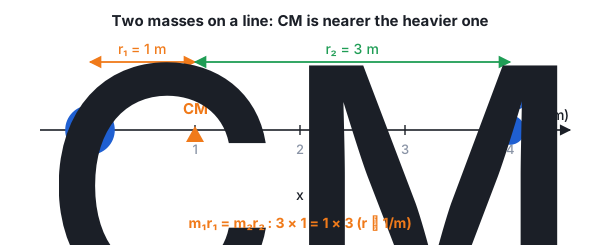
- Two particles: the CM lies on the line joining them, nearer the heavier one, with .
- Uniform symmetric bodies (rod, ring, disc, sphere, cube) have the CM at the geometric centre. It can lie where there is no mass (ring, hollow sphere). Three equal masses at a triangle's corners: CM at the centroid.
- Total momentum and . Internal forces cancel in pairs and cannot change the motion of the CM.
- If , is constant and the CM moves with constant velocity. A nucleus at rest that decays: CM stays at rest, products fly apart in opposite directions.
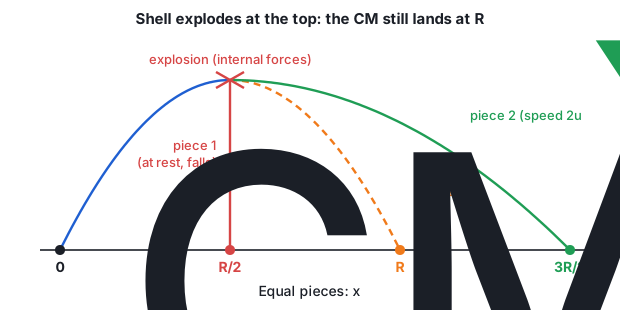
- An exploding projectile: the CM continues on the original parabola until a piece hits the ground (gravity is the only external force).
- Precession: the axis of a spinning top sweeps out a cone about the vertical through its fixed point of contact.
Formulas
- CM of particles; same form for ,
- CM of a continuous body
- Velocity and acceleration of the CM
- Newton's second law for a system
- Conservation of linear momentum
- Two masses a distance apart: distances from the CM
Tips, tricks and hacks
Common mistakes
✗ The CM must be inside the material of the body.
✓ For a ring, a hollow sphere or an L-shaped frame the CM is in empty space.
✗ An explosion changes the path of the CM.
✓ Explosion forces are internal; only external forces (here gravity) decide the CM's path.
✗ For a body with a hole, subtract the hole's coordinate directly.
✓ Weight it by mass: use in the CM formula and divide by .
NEET traps
"The CM of a system moves only under external forces" is TRUE; options saying friction between two parts of the system shifts the CM are wrong.
NEET asks the CM of a triangle of three equal masses or of a semicircle-type body: for equal masses use the centroid, and use symmetry to kill one coordinate first.
After one fragment of an exploding shell lands, the ground exerts a force on it, so the CM no longer follows the parabola. The parabola rule holds only while all pieces are in the air.
Quick check: A projectile of range explodes at its highest point into two equal pieces. One piece retraces its path back to the launch point. Where does the other piece land (from the launch point)?
Answer: C. Both pieces land together and the CM still lands at : , so .
Topic 2 · 🔒
Torque and angular momentum
Key points, graphs, every formula, tricks, common mistakes and NEET traps for this topic are inside Dhruv.
Start freeTopic 3 · 🔒
Moment of inertia, parallel and perpendicular axes
Key points, graphs, every formula, tricks, common mistakes and NEET traps for this topic are inside Dhruv.
Start freeTopic 4 · 🔒
Rotational dynamics and equilibrium
Key points, graphs, every formula, tricks, common mistakes and NEET traps for this topic are inside Dhruv.
Start freeTopic 5 · 🔒
Rolling motion
Key points, graphs, every formula, tricks, common mistakes and NEET traps for this topic are inside Dhruv.
Start freePractise System of Particles and Rotational Motion questions
Topic-wise practice from Level 1 to Level 3, NCERT-based questions and NEET PYQs, with a full solution after every answer.
Start practising free