Class 11 Physics · NCERT notes for NEET
Work, Energy and Power: NCERT Notes, Formulas and Tricks for NEET
How forces transfer energy: work, kinetic and potential energy, conservation of energy, power, collisions and motion in a vertical circle. NEET asks from this chapter regularly, and its energy method is used again in rotation, gravitation, SHM and electrostatics.
- 1. Work done by constant and variable forces
- 2. Kinetic and potential energy, work-energy theorem 🔒
- 3. Conservation of mechanical energy 🔒
- 4. Power 🔒
- 5. Collisions 🔒
- 6. Motion in a vertical circle 🔒
Topic 1 is open for everyone. The full chapter, quick revision and practice open with a plan, or start free with 5 full chapters.
Open the interactive version (simulations and tap-to-answer quick checks).
Topic 1
Work done by constant and variable forces
Carry a heavy school bag along a flat road for an hour and you feel tired, yet the work you do on the bag is almost zero: your force is up, the bag moves sideways.
- Scalar (dot) product: . It is commutative and distributive, and it is zero when the vectors are perpendicular.
- Unit vectors: and , so .
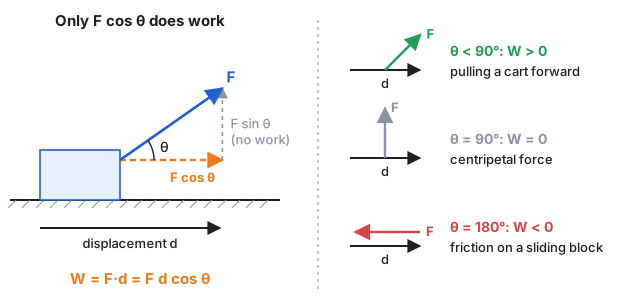
- Work by a constant force = (component of force along the displacement) displacement: .
- Work is a scalar. SI unit joule, ; dimensions .
- No work is done if the displacement is zero, the force is zero, or the force is perpendicular to the displacement ().
- Work is positive for and negative for . Friction on a sliding block and gravity on a rising ball do negative work.
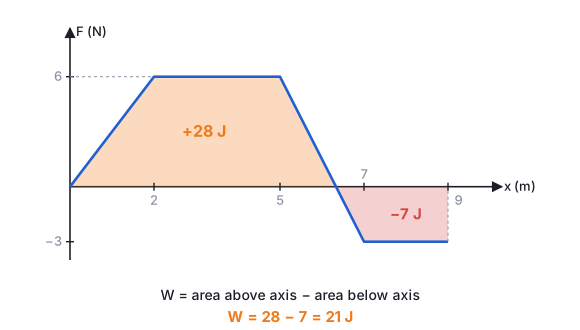
- Variable force: = area under the - graph. Area below the -axis counts as negative.
- Work depends on the frame of reference, because displacement does.
- Other energy units: , , , .
Formulas
- Constant force; = angle between and
- When vectors are given in form
- Variable force; equals signed area under the - graph
- Angle between two vectors
Tips, tricks and hacks
Common mistakes
✗ Holding a heavy load still (or walking on level ground with it) is hard work, so .
✓ Displacement along the force is zero, so physical work on the load is zero; your muscles spend energy internally.
✗ Work is a vector because force and displacement are vectors.
✓ The dot product of two vectors is a scalar; work has sign but no direction.
✗ Area under the - curve below the axis is added as positive.
✓ Area below the axis means force opposite to displacement, so that work is negative.
NEET traps
NEET asks for the work done by a particular force (for example friction or gravity), not the net force. Only the net-force work equals the change in KE.
Static friction can do positive work on a body in the ground frame: a box on an accelerating truck is pushed forward by static friction.
A force given as with displacement between two points: use , not alone.
Quick check: A force N moves a particle from m to m. The work done is
- 2 J
- 10 J
- 5 J
- 0 J
Answer: A. m, so J.
Topic 2 · 🔒
Kinetic and potential energy, work-energy theorem
Key points, graphs, every formula, tricks, common mistakes and NEET traps for this topic are inside Dhruv.
Start freeTopic 3 · 🔒
Conservation of mechanical energy
Key points, graphs, every formula, tricks, common mistakes and NEET traps for this topic are inside Dhruv.
Start freeTopic 4 · 🔒
Power
Key points, graphs, every formula, tricks, common mistakes and NEET traps for this topic are inside Dhruv.
Start freeTopic 5 · 🔒
Collisions
Key points, graphs, every formula, tricks, common mistakes and NEET traps for this topic are inside Dhruv.
Start freeTopic 6 · 🔒
Motion in a vertical circle
Key points, graphs, every formula, tricks, common mistakes and NEET traps for this topic are inside Dhruv.
Start freePractise Work, Energy and Power questions
Topic-wise practice from Level 1 to Level 3, NCERT-based questions and NEET PYQs, with a full solution after every answer.
Start practising free