Class 11 Physics · NCERT notes for NEET
Laws of Motion: NCERT Notes, Formulas and Tricks for NEET
Newton's three laws, momentum and impulse, friction and the dynamics of circular motion. It is the base of all mechanics; NEET regularly asks on lifts, connected blocks, friction on inclines and banked roads, and the same ideas return in work-energy and rotation.
- 1. Newton's laws and momentum
- 2. Free-body diagrams, connected bodies, pulleys
- 3. Friction
- 4. Dynamics of circular motion
- 5. Impulse and conservation of momentum
- Quick revision
Free chapter: the full notes are open for everyone.
Open the interactive version (simulations and tap-to-answer quick checks).
Topic 1
Newton's laws and momentum
A bus brakes suddenly and you lurch forward. Nothing pushed you: your body simply tried to keep moving. That is inertia.
- Galileo (inclined planes) showed that a body keeps moving with constant velocity if no net force acts. Friction, not a lack of force, stops a rolling ball. Aristotle's idea that motion needs a force is wrong.
- Inertia is the resistance of a body to a change in its state of rest or uniform straight-line motion. Mass is the measure of inertia.
- First law: zero net external force means zero acceleration. Rest and uniform velocity are physically equivalent.
- Momentum is a vector, unit . The same force for the same time gives the same to a light or a heavy body.
- Second law: , which is for constant mass. It is a vector law, so it splits into , , equations.
- For a system, is the total external force only; internal forces cancel. The law is local: at an instant depends on at that instant, not on past motion.
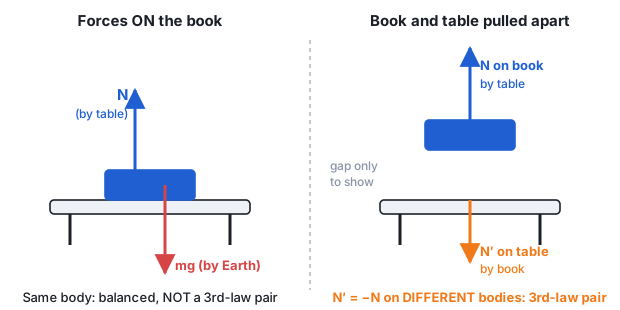
- Third law: . The two forces act on different bodies, at the same instant, with no cause and effect order.
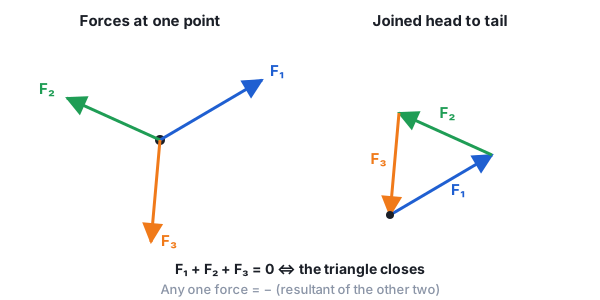
- Equilibrium of a particle: . Three concurrent forces in equilibrium form a closed triangle head to tail.
- Gravity acts at a distance. Normal reaction, tension, friction, spring force and fluid forces are contact forces.
- Newton's laws hold in inertial (non-accelerating) frames.
Formulas
- Second law; form only for constant mass
- Second law in components
- Third law; the pair acts on two different bodies
- Equilibrium under three concurrent forces
- Unit of force
Tips, tricks and hacks
Common mistakes
✗ A body moving forward must have a net force forward.
✓ Net force decides acceleration, not velocity. A puck gliding on ice has zero net force and still moves.
✗ Action and reaction cancel, so nothing can ever move.
✓ They act on different bodies, so they never cancel for one body. Only forces on the same body can be added.
✗ Weight and normal reaction are a third-law pair.
✓ Both act on the same book. They are equal only because the book is in equilibrium; in a lift they differ.
✗ Mass and weight both measure inertia.
✓ Mass measures inertia and is the same everywhere; weight is a force and changes with .
NEET traps
NEET option: 'the reaction acts after the action'. False: both act at the same instant, and either one can be called the action.
A stone whirled at constant speed in a circle, or a satellite in orbit, is NOT in equilibrium: its velocity direction changes, so there is a net force.
'Internal forces can accelerate a system' is false: you cannot move a car by pushing its dashboard from inside.
Quick check: A horse pulls a cart and both speed up. Which statement is correct?
- The horse pulls the cart harder than the cart pulls the horse
- The two pulls are equal and opposite; the system speeds up because the ground pushes the horse forward
- The pulls cancel, so the cart moves only due to inertia
- The cart's pull on the horse is zero while accelerating
Answer: B. Third-law forces are always equal and act on different bodies. The external forward force on the system is the ground's friction on the horse's hooves.
Topic 2
Free-body diagrams, connected bodies, pulleys
In a lift that starts going up, a bathroom scale under a 60 kg person can read about 72 kg. Your mass did not change; the push of the floor did.
- Free-body diagram (FBD): isolate one body, draw every external force ON it (weight, normal, tension, friction, applied), choose axes, then write along each axis.
- Never draw forces the body exerts on others. For a chosen system, internal forces are not drawn.
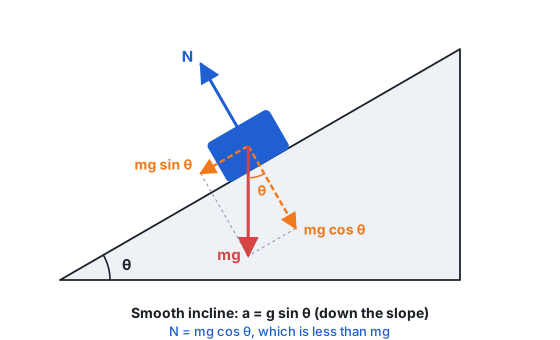
- Normal reaction is perpendicular to the contact surface. It equals only on a level surface with no other vertical forces and no vertical acceleration. On an incline .
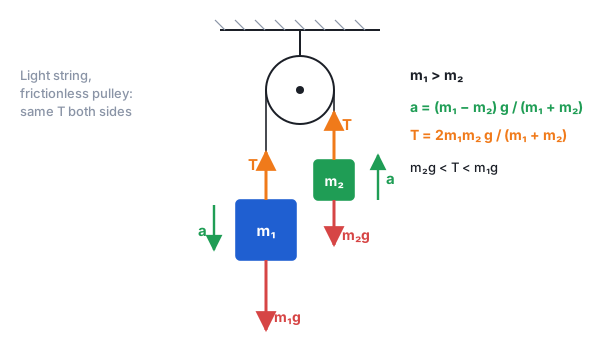
- A light, inextensible string over a light, frictionless pulley has the same tension everywhere.
- Connected bodies share one acceleration. Treat them as one system to get , then isolate one body to get the internal force (tension or contact force).
- Two blocks in contact pushed by on a smooth floor: , and the contact force equals the mass ahead of the contact times .
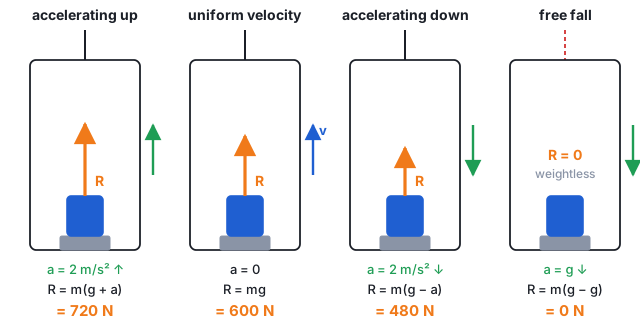
- Lift: apparent weight is the normal reaction . for upward acceleration (or slowing while going down), for downward acceleration, at constant velocity, in free fall.
- Atwood machine (): and , with .
- A heavy rope hanging vertically has the largest tension at the top, since that point supports the whole rope below it.
- NCERT example: a 0.05 kg pebble falling freely has net force N downward, whether it is going up, at the top, or coming down.
Formulas
- Atwood machine,
- Atwood string tension
- Lift accelerating up, or moving down and slowing
- Lift accelerating down, or moving up and slowing
- Smooth incline of angle
- Three blocks pulled at the front by ; tension just behind the front block pulls the two rear blocks
- Block on a smooth table pulled by hanging block
Tips, tricks and hacks
Common mistakes
✗ Normal reaction is always .
✓ It is whatever is needed to stop motion into the surface: on an incline, in a lift, when pulled upward at an angle.
✗ In a lift going down, the scale always reads less.
✓ Reading depends on acceleration. Going down at constant speed it reads ; going down and slowing it reads more than .
✗ Tension in an Atwood string equals the heavier weight .
✓ The heavy block accelerates down, so ; the light block accelerates up, so .
✗ Including 'mv²/r' or 'ma' as a force on the FBD.
✓ An FBD has only real forces from other bodies. is the result of the net force, never an extra arrow.
NEET traps
'A man in a freely falling lift has zero weight.' His true weight is unchanged; only his apparent weight (scale reading) is zero.
In a lift moving up and slowing down, acceleration is downward, so , not .
For blocks in contact, the contact force changes if you push from the other side: it equals the mass ahead of the contact times .
Quick check: A 50 kg man stands on a scale in a lift that is moving down and slowing at 2 m/s². The scale reads (g = 10 m/s²)
- 400 N
- 500 N
- 600 N
- 0 N
Answer: C. Moving down and slowing means acceleration is upward: N.
Topic 3
Friction
Friction is the force that both wastes fuel in your car's engine and lets the tyres grip the road. Without it you could not even walk.
- The contact force between surfaces has two parts: normal reaction (perpendicular) and friction (parallel to the surfaces).
- Friction opposes relative motion, or impending relative motion, between the surfaces in contact. It does not always oppose the motion of the body.
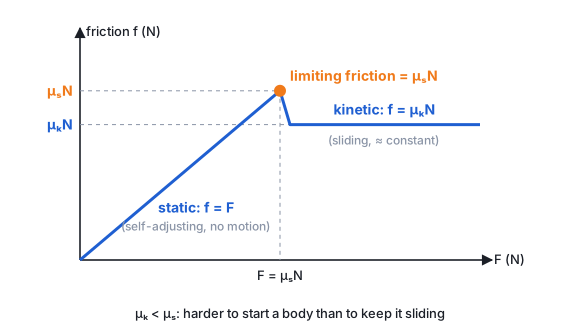
- Static friction is self-adjusting: it equals the applied force, up to the limiting value .
- Limiting friction is (nearly) independent of the area of contact and proportional to . depends only on the pair of surfaces.
- Once sliding starts, kinetic friction acts. It is nearly independent of speed and area, and .
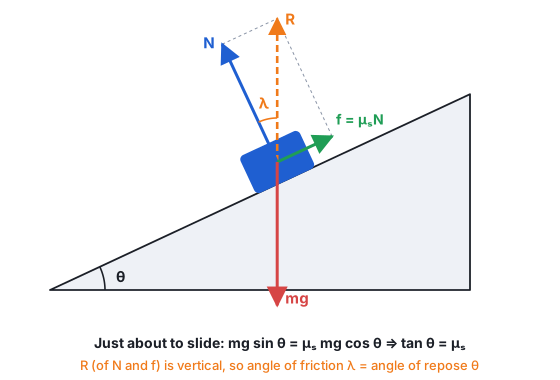
- Angle of friction : the angle between the resultant of and limiting friction and the normal; . Angle of repose (steepest incline on which a body stays at rest) has , so .
- Friction is useful (walking, brakes, turning cars) and harmful (heat and wear in machines). Brakes use kinetic friction to stop motion quickly.
- On a rough floor . After is removed, the body decelerates at .
- NCERT examples: a box on a train floor with stays at rest for train acceleration up to ; a block that just starts sliding at has .
Formulas
- Static friction; equal sign only at the point of slipping
- Kinetic friction
- Angle of repose = angle of friction
- Sliding down a rough incline
- Deceleration while sliding up a rough incline
- Stopping distance on a level rough road
- Largest acceleration of a truck so that a box on it does not slip
Tips, tricks and hacks
Common mistakes
✗ Static friction is always .
✓ is only its maximum. Below that, static friction equals the applied force.
✗ Friction always acts opposite to the direction of motion of the body.
✓ It opposes relative slipping. On an accelerating truck, friction on a box points forward; on a walking foot, it points forward too.
✗ Wider tyres or bigger contact area give more limiting friction.
✓ Limiting friction is (nearly) independent of area; it depends on and .
✗ Pushing at an angle downward is as easy as pulling at an angle upward.
✓ Pushing down adds to and so to friction; pulling up reduces . Pulling is easier.
NEET traps
A block at rest on an incline: friction is , NOT , unless it is just about to slide.
'Friction is self-adjusting' is true for static friction only; kinetic friction has a fixed value .
Quick check: A 4 kg block rests on a floor with and . A horizontal push of 15 N is applied. The friction force on it is (g = 10 m/s²)
- 20 N
- 16 N
- 15 N
- 0 N
Answer: C. Limiting friction is N, which is more than 15 N, so the block stays at rest and static friction balances the push: 15 N.
Topic 4
Dynamics of circular motion
Race tracks and highway curves are tilted inward on purpose. The tilt lets the road itself push the car around the bend.
- A body moving on a circle of radius at speed needs a net force toward the centre (centripetal force).
- Centripetal force is not a new kind of force. Tension, gravity, friction, normal reaction or their components supply it.
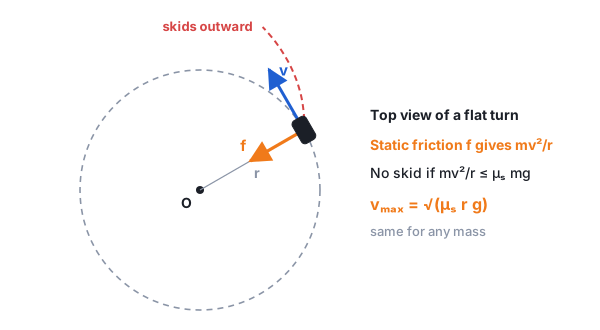
- Stone on a string: tension. Moon around Earth: gravity. Car on a flat curve: static friction from the road.
- Flat curve: no skidding if , so , independent of the car's mass.
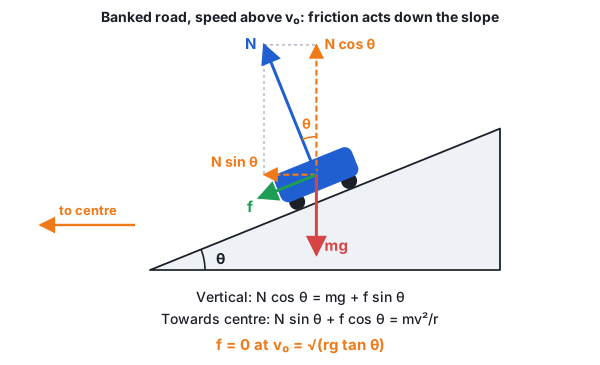
- Banked road: the horizontal component of the normal reaction supplies part (or all) of . This allows higher safe speeds and reduces tyre wear.
- At the optimum speed no friction is needed. Above friction acts down the slope; below it acts up the slope.
- Maximum speed on a banked road: . With it reduces to .
- A cyclist on a turn leans inward by angle from the vertical, with .
- NCERT example: a cyclist at 18 km/h ( m/s) on a flat turn of radius 3 m with slips, since but .
- NCERT example: radius 300 m, banking , : optimum speed about 28.1 m/s, maximum speed about 38.1 m/s.
Formulas
- Centripetal force, the net force toward the centre
- Flat curve
- Banked road, no friction needed
- Banked road with friction
- Banking angle for speed ; also the lean angle of a cyclist
Tips, tricks and hacks
Common mistakes
✗ Drawing centripetal force as an extra arrow along with tension or friction.
✓ Centripetal force is the net inward force; it is already made of the real forces on the FBD.
✗ Centrifugal force throws the car outward when it skids.
✓ In the ground frame there is no outward force. The car skids because friction is too small to supply ; it tends to move straight on.
✗ A heavier car can take a curve faster because it has more friction.
✓ Friction grows with , but the required force grows with too; mass cancels.
✗ On a banked road friction always acts down the slope.
✓ Only above . Below it acts up the slope; at it is zero.
NEET traps
'Uniform circular motion has constant velocity' is false: speed is constant, but velocity direction changes, so the net force is not zero.
In use static friction, not kinetic, because the tyres do not slip sideways while turning safely.
For a banked road question that says 'no friction', the answer is ; the term should not appear.
Quick check: A curve of radius 90 m is banked so that cars at 54 km/h need no friction. Taking g = 10 m/s², tan θ equals
- 0.25
- 0.5
- 0.75
- 1.0
Answer: A. m/s, so .
Topic 5
Impulse and conservation of momentum
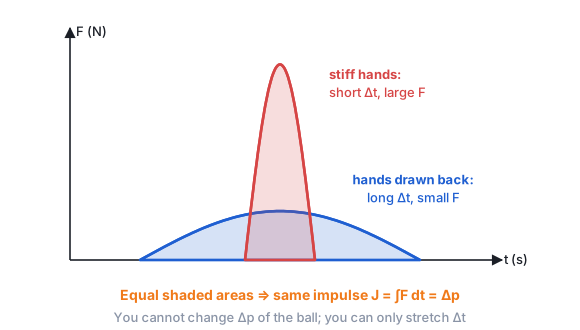
A cricketer catching a fast ball pulls the hands back. The ball still stops, but the force on the palms drops sharply.
- Impulse . It is a vector, unit N s (same as ). For a varying force, impulse is the area under the - graph.
- Impulsive force: a large force for a very short time (bat on ball, hammer on nail). We judge it by the change in momentum it produces.
- For a fixed , a longer contact time means a smaller force: pulling hands back while catching, airbags, sand pits for long jump, packing straw for glassware.
- Conservation of momentum: if the net external force on a system is zero, its total momentum stays constant. It follows from the second and third laws.
- In any collision or explosion, internal forces are equal and opposite and act for the same time, so the momentum lost by one body is gained by the other.
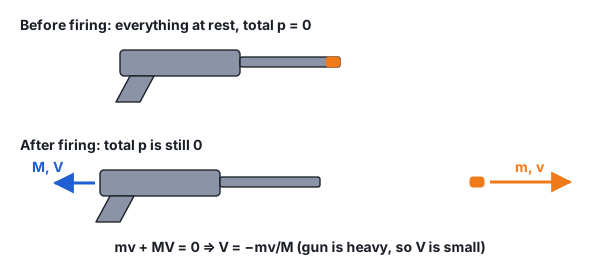
- Gun recoil: total momentum is zero before firing, so ; the heavy gun moves back slowly.
- Momentum along one direction is conserved if no external force acts along that direction, even if other components change.
- A shell exploding in flight: just after the burst, the fragments' total momentum equals the shell's momentum just before.
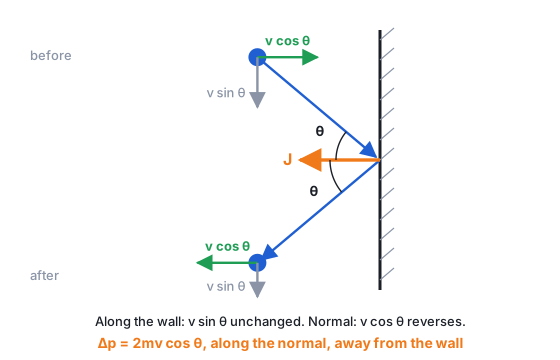
- NCERT example: a ball turned back by a bat through with the same speed gets an impulse along the normal to the bat, of size , because only the normal component of velocity reverses.
- Kinetic energy need not be conserved in a collision even when momentum is.
Formulas
- Impulse-momentum theorem
- Impulse of a variable force = area under the - graph
- Two-body collision with no external force
- Recoil of a gun of mass firing a bullet at speed
- Ball at angle to the normal rebounding with the same speed
- Force for a mass flow rate at speed (machine gun, water jet, conveyor)
Tips, tricks and hacks
Common mistakes
✗ A ball bouncing back with the same speed has zero change in momentum.
✓ Momentum is a vector. Going from to is a change of .
✗ Pulling the hands back reduces the change in momentum of the ball.
✓ The ball still goes from to zero, so is the same. Only the time increases and the force decreases.
✗ Momentum is conserved in every situation.
✓ Only when the net external force is zero (or negligible during a very short collision). A ball falling under gravity does not conserve momentum.
✗ If momentum is conserved, kinetic energy is also conserved.
✓ In an inelastic collision or an explosion, kinetic energy changes while total momentum stays the same.
NEET traps
Angled impact: NEET gives the angle with the wall instead of with the normal. If is with the wall, .
The area under the - graph gives , not the final momentum; add the initial momentum to get .
Two bodies released from rest pushing each other apart (a spring between them): total momentum stays zero, so their speeds are in the inverse ratio of their masses.
Quick check: A 0.5 kg ball hits a wall at 10 m/s along the normal and rebounds at 8 m/s. Contact lasts 0.1 s. The average force on the ball is
- 10 N
- 20 N
- 90 N
- 180 N
Answer: C. N s because the direction reverses; N.
Quick revision: Laws of Motion the night before NEET
- No force is needed for uniform motion; mass is the measure of inertia.
- ; for constant mass ; acceleration is always along net force.
- Action and reaction act on different bodies, at the same instant, and never cancel.
- Weight and normal reaction on a book are NOT a third-law pair.
- Lift: for upward , for downward , in free fall.
- Atwood: , .
- Smooth incline: , .
- Static friction is self-adjusting up to ; ; .
- Angle of repose = angle of friction: .
- Rolling friction is much smaller than sliding friction (ball bearings).
- Flat curve: ; banked, no friction: ; no mass in either.
- Centripetal force is the net inward force supplied by real forces, never an extra force.
- Impulse = area under - graph, unit N s.
- Rebound with the same speed: (head-on) or (angle with normal).
- No external force: total momentum is conserved; gun recoil .
Practise Laws of Motion questions
Topic-wise practice from Level 1 to Level 3, NCERT-based questions and NEET PYQs, with a full solution after every answer.
Start practising free