Class 11 Physics · NCERT notes for NEET
Motion in a Plane: NCERT Notes, Formulas and Tricks for NEET
Vectors, then their use in 2D motion: projectiles, uniform circular motion and relative velocity. NEET asks a question from here almost every year, mostly projectile ratios, vector resultants and centripetal acceleration.
- 1. Vectors: addition, resolution, products
- 2. Projectile motion 🔒
- 3. Uniform circular motion 🔒
- 4. Relative velocity in two dimensions 🔒
Topic 1 is open for everyone. The full chapter, quick revision and practice open with a plan, or start free with 5 full chapters.
Open the interactive version (simulations and tap-to-answer quick checks).
Topic 1
Vectors: addition, resolution, products
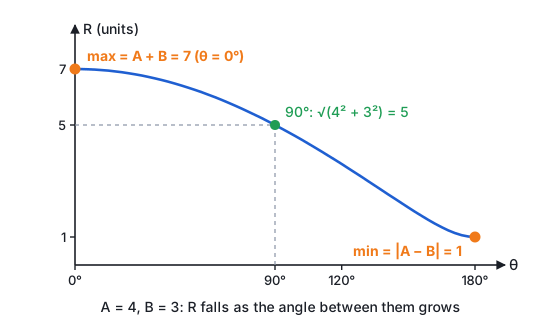
Two people pull a box with 4 N and 3 N at right angles. The box feels 5 N, not 7 N. Directions change the answer.
- Scalars have only magnitude (mass, distance, time, work). Vectors have magnitude and direction (displacement, velocity, force) and add by the triangle or parallelogram law.
- Two vectors are equal only if both magnitude and direction match. with only stretches ; also reverses it.
- Addition is commutative and associative. Subtraction means adding the reverse: .
- Null vector : zero magnitude, no definite direction. , , .
- Unit vector has magnitude 1 and no unit or dimension. point along and are mutually perpendicular.
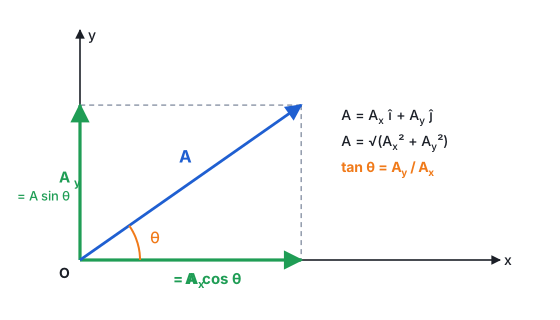
- Resolution: a vector at angle with the -axis has , . In space , , with .
- Analytical addition: add component by component, , , .
- The resultant of two vectors always lies between (opposite) and (parallel). Perpendicular vectors give .
- Dot product is a scalar; zero when . , .
- Cross product , direction by the right-hand rule, zero for parallel vectors; . Cyclic: , , .
Formulas
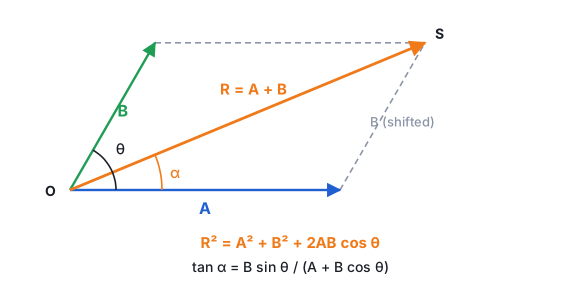
- Magnitude of ; = angle between them
- Direction of measured from
- Law of sines in the vector triangle
- Magnitude of the difference (note the minus sign)
- ,Magnitude and direction from components
- Then
- Also the area of the parallelogram made by and
Tips, tricks and hacks
Common mistakes
✗ Adding magnitudes: 3 N + 4 N = 7 N always.
✓ Only when they point the same way. In general use ; at it is 5 N.
✗ Using for .
✓ Reversing changes the angle to , so the sign becomes minus.
✗ Taking as the angle when vectors are drawn head to tail.
✓ in the formula is the angle with tails joined. Shift the vectors tail to tail before reading the angle.
✗ Thinking like the dot product.
✓ Cross product is anti-commutative; swapping the order flips the direction.
NEET traps
Two vectors of unequal size can never add to zero; three coplanar vectors can (if they form a closed triangle).
Current and pressure have a direction in daily talk but are scalars; current does not add by the vector law.
A unit vector has no unit. " has unit of the original vector" is a wrong option.
Quick check: Two forces of equal magnitude act on a body and the resultant also has magnitude . The angle between the forces is
Answer: C. gives , so and .
Topic 2 · 🔒
Projectile motion
Key points, graphs, every formula, tricks, common mistakes and NEET traps for this topic are inside Dhruv.
Start freeTopic 3 · 🔒
Uniform circular motion
Key points, graphs, every formula, tricks, common mistakes and NEET traps for this topic are inside Dhruv.
Start freeTopic 4 · 🔒
Relative velocity in two dimensions
Key points, graphs, every formula, tricks, common mistakes and NEET traps for this topic are inside Dhruv.
Start freePractise Motion in a Plane questions
Topic-wise practice from Level 1 to Level 3, NCERT-based questions and NEET PYQs, with a full solution after every answer.
Start practising free