Class 11 Physics · NCERT notes for NEET
Motion in a Straight Line: NCERT Notes, Formulas and Tricks for NEET
Kinematics in one dimension: displacement, velocity, acceleration, the equations of motion, graphs, relative velocity and free fall. It is the language of all of mechanics, and NEET usually asks at least one direct question from it, often through a graph.
- 1. Position, displacement, speed and velocity
- 2. Acceleration and equations of motion
- 3. Motion graphs (x-t, v-t, a-t)
- 4. Relative velocity in one dimension
- 5. Free fall and vertical motion
- Quick revision
Free chapter: the full notes are open for everyone.
Open the interactive version (simulations and tap-to-answer quick checks).
Topic 1
Position, displacement, speed and velocity
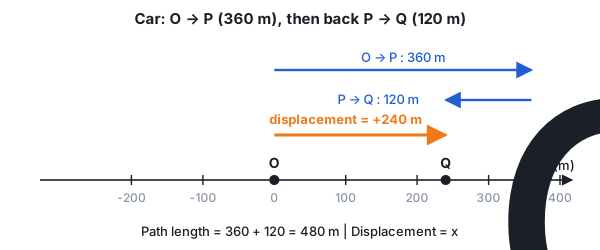
Walk 1 km to the shop and come back home: your speedometer app says 2 km, but your displacement is exactly zero.
- Motion along a straight line is rectilinear motion. Choose an origin O and a positive direction; position then carries a sign.
- Rest and motion are relative: a body moves if its position changes with time with respect to the chosen frame of reference.
- Path length (distance) is the total length actually travelled. It is a scalar and is never negative.
- Displacement is the change in position. It is a vector in 1D: it can be positive, negative or zero.
- path length. They are equal only if the body moves in one direction without turning back.
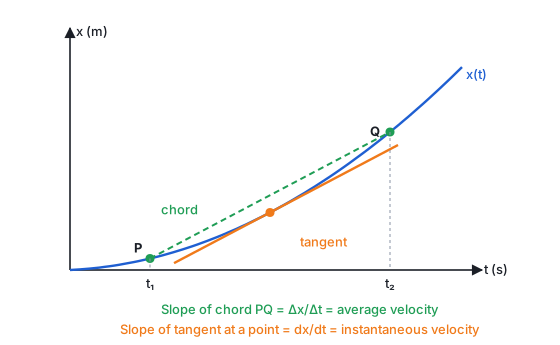
- Average velocity ; average speed path length / time. So average speed |average velocity|.
- Instantaneous velocity is the slope of the tangent to the - graph. Instantaneous speed is simply .
- Uniform motion: equal displacements in equal time intervals. Then instantaneous velocity equals average velocity at every instant.
- SI unit . Convert with (so ).
- Round trip back to the start: displacement and average velocity are zero, but average speed is not.
Formulas
- Average velocity; sign shows direction
- Always positive
- Instantaneous velocity
- Equal distances covered at and (harmonic mean)
- Equal time intervals at and (arithmetic mean)
Tips, tricks and hacks
Common mistakes
✗ Average speed = |average velocity| always.
✓ Only when there is no turning back. In a round trip average velocity is 0 but average speed is not.
✗ Average speed for two equal halves of a journey = .
✓ For equal distances the body spends more time at the lower speed, so use .
✗ Distance = even when the body reverses.
✓ Find where , split the motion there and add the magnitudes of each part.
NEET traps
NEET gives a body on a circle or a round trip and asks average velocity: the answer is zero (or chord/time), not path/time.
"Instantaneous speed equals magnitude of instantaneous velocity" is TRUE, even though average speed and |average velocity| can differ.
Displacement can be zero while distance is not; but distance can never be zero while displacement is non-zero.
Quick check: A car covers the first half of a distance at 30 km/h and the second half at 60 km/h. Its average speed is
- 45 km/h
- 40 km/h
- 50 km/h
- 42 km/h
Answer: B. Equal distances: km/h.
Topic 2
Acceleration and equations of motion
Double your bike's speed and you need four times the road to stop. That one fact is why speed limits near schools are so low.
- Average acceleration ; instantaneous acceleration . SI unit .
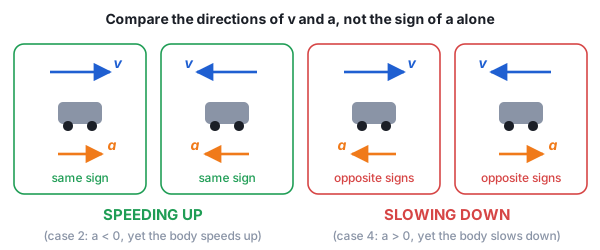
- Acceleration can be positive, negative or zero. Its sign alone does not tell you whether the body speeds up.
- The body speeds up when and have the same sign and slows down when they have opposite signs.
- can be zero while is not zero, for example at the top of a vertical throw.
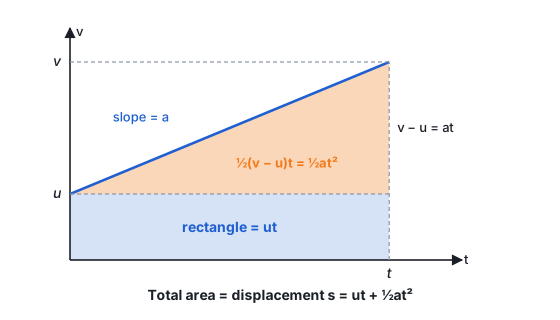
- For constant only: , , , and .
- These equations can be derived from the area under the - graph (rectangle + triangle ) or by integration.
- Stopping distance for deceleration of size : .
- Reaction time: NCERT drops a ruler between your fingers; if it falls before you catch it, (21 cm gives about 0.2 s).
- Non-uniform acceleration: use calculus. , , or when depends on .
Formulas
- Velocity after time (constant )
- Displacement in time
- Use when time is not given or not asked
- Use when is not given
- Displacement in the th second
- Stopping distance; = size of deceleration
- Use when is given as a function of
Tips, tricks and hacks
Common mistakes
✗ Negative acceleration means the body is slowing down.
✓ Slowing down needs and in opposite directions; a body moving in with speeds up.
✗ Using when changes with time (e.g. ).
✓ The three equations need constant ; otherwise integrate with respect to .
✗ Taking from as the distance even when the body has reversed.
✓ is displacement. If becomes zero inside the interval, find the two parts and add their sizes.
NEET traps
"A body can have zero velocity and non-zero acceleration": TRUE (top of a throw). "Non-zero velocity and zero acceleration": also TRUE (uniform motion).
Stopping-distance questions often give the speed in km/h; convert first or use the ratio directly.
The ratio of distances in the th and th second from rest is , not .
Quick check: A car moving at 54 km/h stops in 15 m with uniform braking. With the same braking, the stopping distance at 108 km/h is
- 30 m
- 45 m
- 60 m
- 120 m
Answer: C. ; speed doubles so distance becomes m.
Topic 3
Motion graphs (x-t, v-t, a-t)
One look at a graph's slope and area gives velocity, acceleration and displacement without a single equation; NEET loves to hide the answer in a graph.
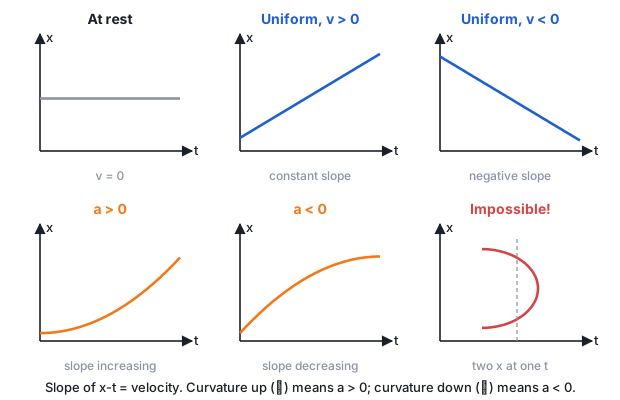
- Slope of the - graph is velocity: chord slope gives average velocity, tangent slope gives instantaneous velocity.
- At rest: - is a horizontal line. Uniform motion: a straight inclined line (positive slope for , negative for ).
- Uniform acceleration: - is a parabola. Curving upward means , curving downward means .
- Slope of the - graph is acceleration. A straight - line means constant acceleration.
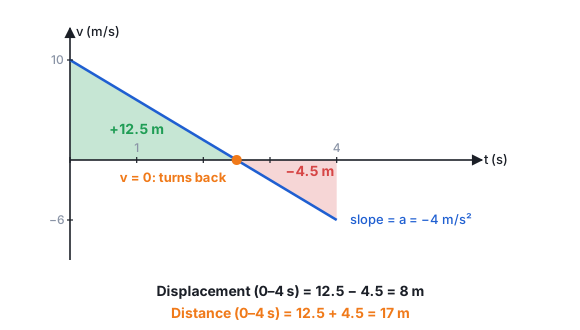
- Area under the - graph is displacement; area below the time axis counts as negative. Adding all areas as positive gives distance.
- Area under the - graph is the change in velocity .
- Where the - graph crosses the time axis, the body turns back. At that point the - graph has a maximum or minimum.
- Impossible graphs: an - curve with two values of at one , a speed-time graph going below zero, or a vertical - segment (infinite velocity).
- Area under the - graph has no useful meaning; never use it.
Formulas
- = slope of -Tangent slope at that instant
- = slope of -Acceleration from the velocity-time graph
- Signed area under - = displacement
- Area under - = change in velocity
Tips, tricks and hacks
Common mistakes
✗ Reading the steepness angle with a protractor to get velocity.
✓ Slope is in the axis units; the drawn angle depends on the scale chosen.
✗ Taking area under - as distance even when part of it lies below the axis.
✓ Signed sum = displacement; sum of magnitudes = distance.
✗ Thinking a - graph crossing zero means the body stops for some time.
✓ It is at rest only for an instant and then reverses; a flat segment on would mean staying at rest.
NEET traps
NEET shows an - parabola and asks the sign of : decide from curvature (∪ or ∩), not from whether is rising.
A question asks "which graph is not possible": look for two values at one , negative speed or negative distance.
For - graphs, the answer option with "total area" is distance and "net area" is displacement; both are usually offered.
Quick check: The velocity of a body changes uniformly from m/s to m/s in 4 s. The distance travelled in these 4 s is
- 0 m
- 6 m
- 12 m
- 24 m
Answer: C. at 2 s. Two triangles each m; distance m (displacement is 0).
Topic 4
Relative velocity in one dimension
From a train at 80 km/h, a car on the next road at 80 km/h looks parked; a train coming the other way flashes past at 160 km/h.
- Velocity of A relative to B is how fast A's position changes as seen by B: .
- : same size, opposite sign.
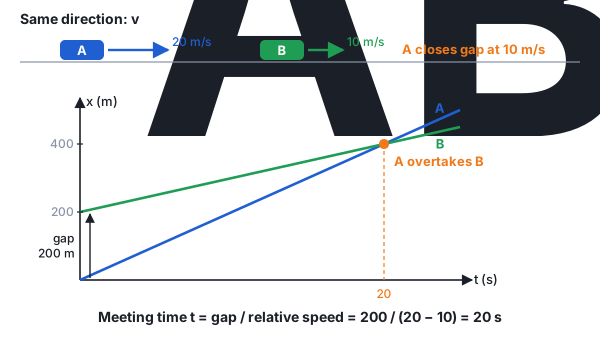
- Same direction: relative speed is the difference of speeds. Opposite directions: relative speed is the sum.
- If , the gap stays constant and their - graphs are parallel lines.
- If A is behind B but faster, the gap shrinks at ; the - lines meet at the overtaking point.
- Relative position and relative acceleration follow the same rule.
- Two freely falling bodies have the same acceleration , so and their relative velocity stays constant.
- Time to meet or overtake = initial gap / relative speed (constant velocities).
Formulas
- Velocity of A relative to B; use signs with one common positive direction
- Reverse the observer, reverse the sign
- Time to close a gap at constant relative speed
- Time for two trains of lengths , to cross each other completely
Tips, tricks and hacks
Common mistakes
✗ Writing .
✓ First subscript is the body, second is the observer: .
✗ Subtracting speeds even for bodies moving towards each other.
✓ Put signs first: and give .
✗ For two trains crossing, using only one train's length.
✓ Crossing is complete when the tail of one passes the tail of the other, so the relative distance is .
NEET traps
"Two balls in free fall: their relative velocity is zero" is FALSE in general; it is constant, and zero only if they had equal velocities at the start.
Answer options often swap and ; the sizes are equal, so check the sign or direction asked.
If two bodies move with equal velocities, their - graphs are parallel; parallel - graphs mean equal accelerations, not equal velocities.
Quick check: Trains of length 100 m and 150 m move on parallel tracks in opposite directions at 54 km/h and 36 km/h. The time they take to cross each other is
- 10 s
- 25 s
- 50 s
- 16.7 s
Answer: A. Relative speed m/s; distance m; s.
Topic 5
Free fall and vertical motion
In a vacuum tube a feather and a coin hit the bottom together; on the Moon, astronaut David Scott showed the same with a hammer and a feather.
- Free fall: motion under gravity alone, air resistance neglected. Acceleration is downward, the same for all masses.
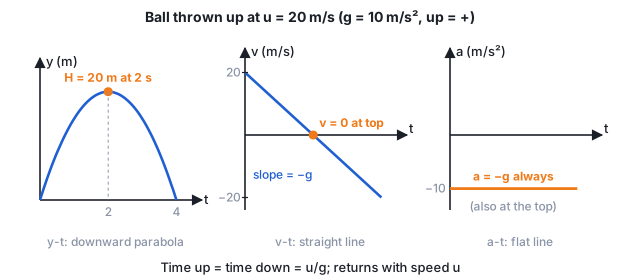
- With upward as positive, for the whole flight: going up, at the top and coming down.
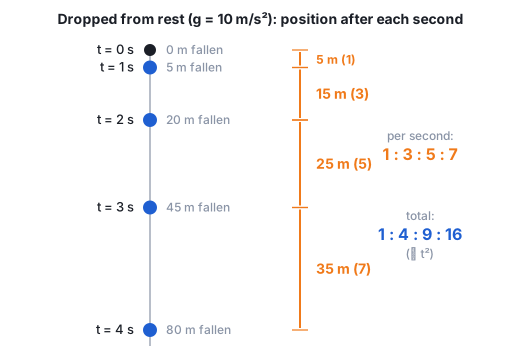
- Dropped from rest: , , , .
- Thrown up with speed : time to top , maximum height , total time back to the hand .
- At the highest point but downward; the body is not in equilibrium.
- Without air resistance, time up = time down, and the body passes every height with the same speed going up and coming down.
- Galileo's law of odd numbers: from rest, distances in successive equal time intervals are ; total distances are .
- For a ball thrown up: - is a downward parabola, - a straight line of slope crossing zero at the top, - a flat line at .
- NCERT example: thrown up at from a 25 m building (): it rises 20 m more and hits the ground after 5 s.
Formulas
- Maximum height for a vertical throw with speed
- Total time of flight back to the launch point
- Speed after falling height from rest
- Time to fall height from rest
- Height with upward positive; works for the whole flight
Tips, tricks and hacks
Common mistakes
✗ At the highest point acceleration is zero because the body stops.
✓ Only velocity is zero there; gravity still acts, so downward.
✗ Heavier bodies fall faster.
✓ In free fall for every mass; differences in real life come from air resistance.
✗ Switching the sign of when the ball starts coming down.
✓ Fix one positive direction for the whole motion; (up positive) going up and coming down.
NEET traps
"At the top of its path, velocity and acceleration are both zero": FALSE; only velocity is zero.
"Distances in successive seconds are in ratio 1 : 4 : 9": FALSE; that is total distance. Successive seconds give 1 : 3 : 5.
A ball thrown down with speed and one thrown up with the same from the same height hit the ground with the same speed (but at different times).
Quick check: A ball thrown vertically upward returns to the thrower's hand after 6 s. Taking , the maximum height reached is
- 30 m
- 45 m
- 90 m
- 180 m
Answer: B. Time up s, so m/s and m.
Quick revision: Motion in a Straight Line the night before NEET
- Distance is never negative; displacement can be , or zero; distance.
- Average speed |average velocity|; equal only with no turning back.
- Equal distances at , : ; equal times: .
- ; 72 km/h = 20 m/s.
- , , need constant .
- ; from rest, successive-second distances go .
- Stopping distance : double the speed, four times the distance.
- Speeding up if and have the same sign; slowing down if opposite.
- Slope of - = velocity; slope of - = acceleration.
- Area under - = displacement (signed) or distance (all positive); area under - = .
- - crossing zero = turning point; - ∪ means , ∩ means .
- , ; opposite directions add speeds.
- Two freely falling bodies: relative velocity constant.
- Vertical throw: , , time up = time down.
- At the top: but downward.
Practise Motion in a Straight Line questions
Topic-wise practice from Level 1 to Level 3, NCERT-based questions and NEET PYQs, with a full solution after every answer.
Start practising free