Class 11 Physics · NCERT notes for NEET
Units and Measurements: NCERT Notes, Formulas and Tricks for NEET
How we measure, which units we use, how dimensions check an equation, and how errors and significant figures tell you how much to trust a number. It is a short chapter, but NEET almost always asks something from it, most often dimensions or error propagation.
- 1. SI units and unit systems
- 2. Dimensions and dimensional analysis
- 3. Errors in measurement
- 4. Significant figures
- Quick revision
Free chapter: the full notes are open for everyone.
Open the interactive version (simulations and tap-to-answer quick checks).
Topic 1
SI units and unit systems
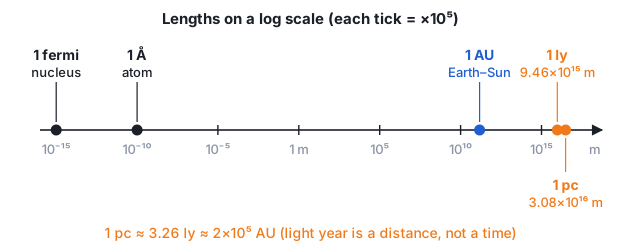
1 parsec is so large that light takes about 3.26 years to cross it, yet it is measured with nothing more than an angle and a known baseline.
- A physical quantity = number × unit: . A unit is an agreed, reproducible reference standard.
- Fundamental (base) quantities are independent of each other; derived quantities (speed, force, pressure) are built from them.
- Older systems: CGS (cm, g, s), FPS (foot, pound, s), MKS (m, kg, s). SI is the system accepted worldwide today.
- SI has 7 base units: metre (m), kilogram (kg), second (s), ampere (A), kelvin (K), candela (cd), mole (mol).
- Plane angle in radian (rad) and solid angle in steradian (sr). Both are dimensionless; a full sphere is sr.
- For a fixed quantity, : a bigger unit gives a smaller number ().
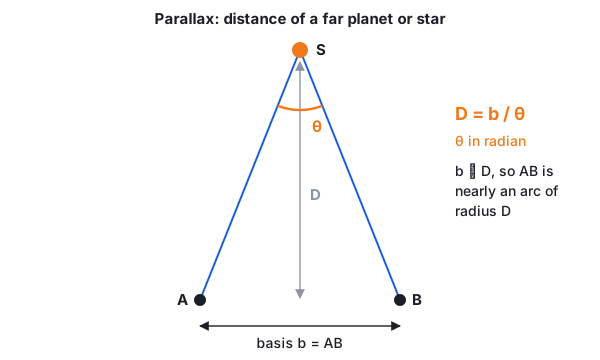
- Parallax: a far object S seen from A and B (basis ) shifts by angle . Then with in radian.
- Small lengths: , . Large: , , .
- Atomic masses use (1/12 of a carbon-12 atom). Cesium atomic clocks (NPL, New Delhi keeps India's standard) define the second.
- Direct length tools: metre scale ( to m), vernier callipers (down to m), screw gauge and spherometer (down to m).
Formulas
- Parallax distance; = basis, in radian
- Size of a far object that subtends angle (rad) at distance
- Also rad
- Solid angle; full sphere sr
- Same quantity in two units
Tips, tricks and hacks
Common mistakes
✗ Light year is a unit of time.
✓ It is the distance light travels in one year, m.
✗ Putting in degrees or arc-seconds in .
✓ The arc formula works only with radian; convert first ( rad).
✗ Thinking a bigger unit gives a bigger number.
✓ : 5 m is 500 cm; the smaller unit needs the bigger number.
NEET traps
Candela (not lumen or watt) is the SI base unit of luminous intensity; mole is a base unit too, while coulomb and newton are not.
Radian and steradian have units but no dimensions; NEET may ask the dimensional formula of solid angle: .
1 parsec > 1 light year > 1 AU. An option ordering them the other way round looks right if you go by how famous the unit is.
Quick check: Two points 1000 km apart observe a distant object with a parallax angle of ( rad). The distance of the object is about
- m
- m
- m
- m
Answer: A. m. Remember to convert km to m.
Topic 2
Dimensions and dimensional analysis
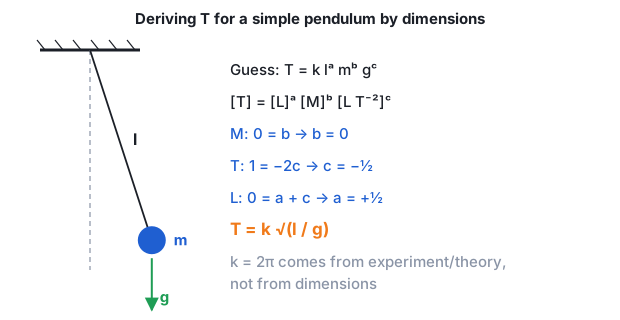
Without solving any physics, you can find that a pendulum's period goes as the square root of its length and does not depend on the bob's mass.
- Dimensions of a quantity are the powers of the base quantities in it. Mechanics uses , , ; current , temperature .
- Dimensional formula: force . Writing is the dimensional equation.
- Principle of homogeneity: only quantities with the same dimensions can be added, subtracted or equated. Every term of a correct equation has the same dimensions.
- Use 1, checking: a dimensionally wrong equation is surely wrong; a dimensionally right one may still be wrong (numbers like are not checked).
- Use 2, converting units: . Example: .
- Use 3, deriving relations: for a simple pendulum; cannot come from dimensions.
- Arguments of , , , must be dimensionless, so in , and .
- Limits: no numerical constants, no sums like by derivation, and at most three unknown powers in mechanics.
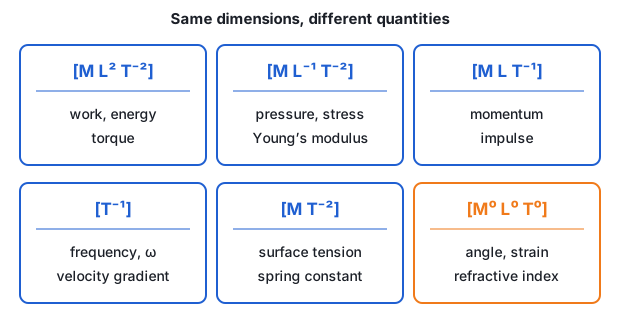
- Dimensionless: angle, strain, refractive index, relative density, coefficient of friction.
- Useful constants: , , , .
Formulas
- Conversion for a quantity
- SI to CGS
- Power
- Force/length; same as spring constant
- Planck's constant; same as angular momentum
- From
Tips, tricks and hacks
Common mistakes
✗ If an equation is dimensionally correct, it is correct.
✓ passes the check but the factor is missing. Dimensions cannot test numbers.
✗ Angle has dimensions because it has a unit (radian).
✓ Angle = arc/radius = L/L, so it is dimensionless though it has a unit.
✗ Torque and work are the same quantity, so torque is in joule.
✓ Same dimensions , but torque is a vector, written in N m, never J.
NEET traps
Planck's constant and angular momentum share ; NEET often puts them as the 'matching pair' option.
In , students write ; it must be so that is dimensionless.
Dimensional analysis cannot derive a relation that has a sum of terms, or a quantity that depends on more than three other quantities (in mechanics M, L, T give only three equations).
Quick check: Which pair has the SAME dimensions?
- Torque and power
- Pressure and Young's modulus
- Momentum and force
- Frequency and angle
Answer: B. Both are force per area, . Power is , force has an extra over momentum, angle is dimensionless.
Topic 3
Errors in measurement
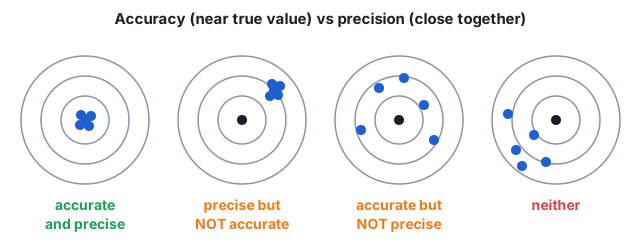
A wrongly set zero on your screw gauge makes all ten readings agree beautifully and all ten wrong: precise, but not accurate.
- Error = difference between true and measured value. Accuracy: how close to the true value. Precision: the resolution and repeatability of the measurement.
- Systematic errors act in one direction: instrumental (bad calibration, zero error), imperfect technique or conditions (temperature, wind), and personal (bias, parallax while reading).
- Random errors are irregular and change sign; taking many readings and averaging reduces them.
- Least count error comes from the resolution of the instrument; the smaller the least count, the higher the precision.
- Mean of readings is the best estimate. Absolute error ; their average is .
- Relative error ; ×100 gives percentage error. Write the result as .
- NCERT pendulum example: 2.63, 2.56, 2.42, 2.71, 2.80 s give mean 2.62 s, mean absolute error 0.11 s, so s, about 4%.
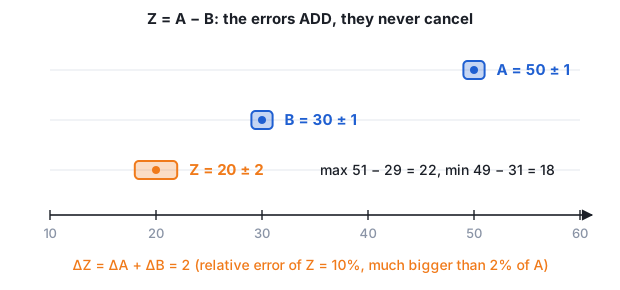
- Sum or difference: absolute errors add. Product or quotient: relative errors add. Power : relative error is multiplied by .
- Resistors in series: .
- In the error is : the highest power contributes most.
Formulas
- Best value and mean absolute error
- Percentage error
- Absolute errors add, also for subtraction
- Relative errors add, also for division
- Powers multiply the relative error
Tips, tricks and hacks
Common mistakes
✗ For , .
✓ Errors never cancel; the worst case adds them: .
✗ For , .
✓ Relative errors add in division too; a minus sign in the power becomes plus in the error.
✗ Adding absolute errors for a product like .
✓ Absolute errors add only for sums and differences; for products and quotients add relative (or %) errors.
✗ Taking more readings removes all errors.
✓ Averaging reduces random error only; a systematic error like zero error stays in every reading.
NEET traps
"Readings are close to each other" describes precision, not accuracy. NEET swaps the two words in options.
When two nearly equal numbers are subtracted, the absolute error adds but the result is small, so the percentage error becomes very large.
Least count error belongs to both random and systematic errors (NCERT line); an option saying 'only random' is wrong.
Quick check: In the percentage errors in , and are 1%, 2% and 1%. The maximum percentage error in is
- 7%
- 4%
- 2%
- 0%
Answer: A. . The power of in the denominator still adds.
Topic 4
Significant figures
Your calculator says 10.63487, but if one reading was 2.51, you are only allowed to write 10.6. The extra digits are fake precision.
- Significant figures = all the reliable digits + the first uncertain digit of a measurement.
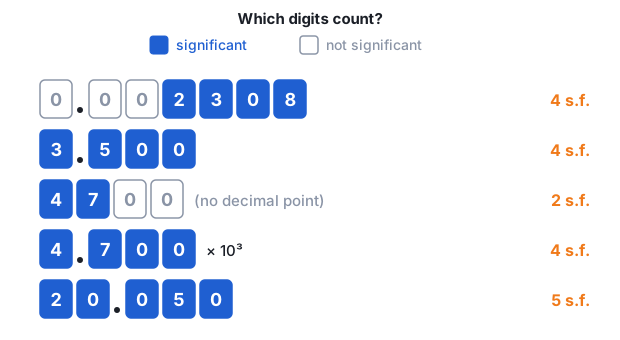
- All non-zero digits are significant, and zeros between non-zero digits are significant: 20.05 has 4.
- In a number less than 1, zeros after the decimal point but before the first non-zero digit are NOT significant: 0.002308 has 4.
- Trailing zeros with no decimal point are not significant (4700 has 2); trailing zeros after a decimal point are significant (3.500 and 0.06900 have 4).
- Changing units does not change significant figures: , all 4.
- Scientific notation with removes doubt: every digit of is significant. m has 4.
- Multiplying or dividing: keep as many significant figures as the input with the fewest. Adding or subtracting: keep as many decimal places as the input with the fewest.
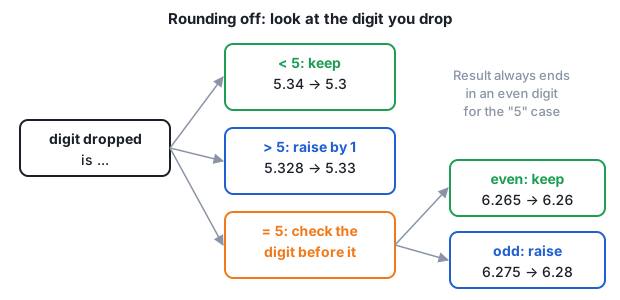
- Rounding: dropped digit < 5, keep; > 5, raise by 1; exactly 5, keep if the previous digit is even, raise if odd (6.265 → 6.26, 6.275 → 6.28).
- Exact numbers (2 in , counted objects) have unlimited significant figures and never limit the answer.
- In multi-step work keep one extra digit in intermediate results; round only the final answer.
Formulas
- 3 s.f., limited by 2.51
- 1 decimal place, limited by 227.2
- Not 2: keep 2 s.f. as in 2.5
Tips, tricks and hacks
Common mistakes
✗ 0.0050 has 4 significant figures.
✓ Leading zeros never count; only 5 and the trailing 0 after the decimal point do, so 2.
✗ Using the decimal-place rule in multiplication.
✓ Decimal places matter only for + and −; for × and ÷ count significant figures.
✗ Converting 3.20 m to 320 cm keeps 3 s.f. automatically.
✓ Plain 320 looks like 2 s.f.; write cm to keep all 3.
NEET traps
NEET asks 'number of significant figures in ': the power of 10 does not matter, the answer is 5.
An option with all calculator digits (like 17.164) looks 'most accurate' but is wrong; the answer must be rounded by the rule.
The odd/even rule applies only when the dropped digit is exactly 5; 6.2651 rounds to 6.27 because the dropped part is more than 5.
Quick check: The sum 12.6 + 0.354 + 4.21, written with correct significant figures, is
- 17.164
- 17.16
- 17.2
- 17
Answer: C. In addition keep the fewest decimal places: 12.6 has one, so 17.164 rounds to 17.2.
Quick revision: Units and Measurements the night before NEET
- SI base units: m, kg, s, A, K, cd, mol (7). Radian and steradian are dimensionless.
- m < m < m.
- m, fermi m, kg.
- Parallax: with in radian; rad.
- Homogeneity: every term of a valid equation has the same dimensions.
- Work, energy, torque: . Pressure, stress, modulus, energy density: .
- , , , surface tension .
- erg, dyne.
- Dimensions cannot give numerical constants or check the factor 1/2.
- Accuracy = closeness to true value; precision = closeness of readings / resolution.
- Random errors fall with averaging; systematic errors do not.
- Sum/difference: absolute errors add. Product/quotient: relative errors add. Power k: k times.
- Multiply/divide: fewest significant figures. Add/subtract: fewest decimal places.
- 0.002308 has 4 s.f.; 3.500 has 4; 4700 has 2; unit change does not change s.f.
- Rounding exactly 5: previous even, keep; previous odd, raise.
Practise Units and Measurements questions
Topic-wise practice from Level 1 to Level 3, NCERT-based questions and NEET PYQs, with a full solution after every answer.
Start practising free