Class 12 Physics · NCERT notes for NEET
Dual Nature of Radiation and Matter: NCERT Notes, Formulas and Tricks for NEET
Light acts as particles (photons) in the photoelectric effect, and moving particles act as waves (de Broglie). It is a short, formula-driven chapter, and NEET almost always sets at least one numerical or graph question from it.
Topic 1 is open for everyone. The full chapter, quick revision and practice open with a plan, or start free with 5 full chapters.
Open the interactive version (simulations and tap-to-answer quick checks).
Topic 1
Photoelectric effect
Shine a dim violet torch on zinc and electrons fly out at once; shine a blinding red floodlight on it and not one electron comes out. Brightness is not the boss here, frequency is.
- Photoelectric effect: electrons are emitted from a metal surface when light of high enough frequency falls on it. These are photoelectrons; their flow is the photocurrent.
- Work function : minimum energy needed to free an electron from the metal surface. It depends on the metal and on its surface; quoted in eV ().
- Threshold frequency : below it there is no emission, however intense the light. Threshold wavelength is the longest wavelength that works; .
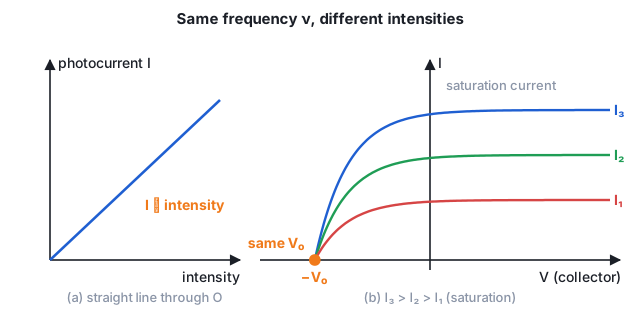
- Intensity effect: for fixed , photocurrent (and saturation current) intensity, because intensity decides the number of photons per second.
- Potential effect: current rises with positive collector potential and levels off at the saturation current when every emitted electron is collected.
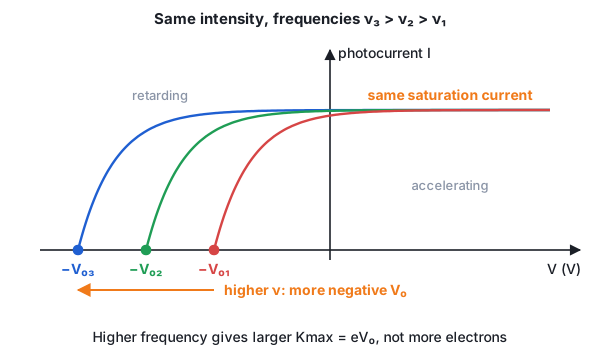
- Stopping potential : the negative collector potential at which the current just becomes zero; . does not depend on intensity.
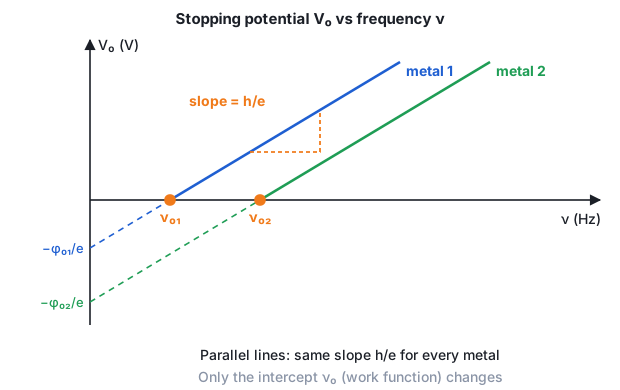
- Frequency effect: and increase linearly with . Higher gives a more negative cut-off on the - graph, with the same saturation current if the intensity is the same.
- Emission is instantaneous (lag below about ) even for very dim light. Wave theory cannot explain the threshold, the -dependence of or this instant emission.
- Einstein: light is a stream of photons of energy . One photon is absorbed by one electron; is spent to escape and the rest is kinetic energy. So .
- Photon: , , speed , zero rest mass, no charge, not deflected by electric or magnetic fields. In collisions energy and momentum are conserved, but photon number need not be. Millikan's - data confirmed Einstein's equation and gave .
Formulas
- Einstein's photoelectric equation
- Stopping potential from maximum kinetic energy
- Straight line: slope , -intercept
- Same law in wavelengths; emission needs
- Fast photon energy;
- Photon momentum
- Photons emitted per second by a source of power
Tips, tricks and hacks
Common mistakes
✗ Brighter light gives faster photoelectrons.
✓ Brighter light means more photons, so more electrons; each photon still has , so is unchanged.
✗ , so doubling doubles .
✓ is linear but not proportional; it is .
✗ Long exposure to sub-threshold light will finally eject electrons.
✓ One photon acts on one electron; if no electron escapes, however long you wait.
✗ Using in metres with 1240.
✓ 1240 is in eV nm, so put in nm (or use J m with in m).
NEET traps
Graph questions: curves with the same but different saturation currents mean different intensities; same saturation but different mean different frequencies.
The slope of the - graph is for every metal; an option saying the slope depends on the metal is wrong. Only changes.
"Stopping potential depends on intensity" and "photocurrent depends on frequency (above )" are both false statements NEET likes to offer.
Quick check: Light of wavelength 310 nm falls on a metal of work function 2.0 eV. The stopping potential is about
- 4.0 V
- 2.0 V
- 6.0 V
- 1.0 V
Answer: B. eV, so eV and V.
Topic 2 · 🔒
Matter waves and de Broglie relation
Key points, graphs, every formula, tricks, common mistakes and NEET traps for this topic are inside Dhruv.
Start freePractise Dual Nature of Radiation and Matter questions
Topic-wise practice from Level 1 to Level 3, NCERT-based questions and NEET PYQs, with a full solution after every answer.
Start practising free