Class 12 Physics · NCERT notes for NEET
Atoms: NCERT Notes, Formulas and Tricks for NEET
How we learnt what is inside an atom: Rutherford's alpha scattering found the tiny nucleus, and Bohr's quantised orbits explained the hydrogen line spectrum. It is a short chapter, and NEET regularly asks quick numericals on Bohr radius, energy levels and spectral lines from it.
Topic 1 is open for everyone. The full chapter, quick revision and practice open with a plan, or start free with 5 full chapters.
Open the interactive version (simulations and tap-to-answer quick checks).
Topic 1
Rutherford model and alpha scattering
If an atom were the size of a cricket stadium, its nucleus would be a small marble at the centre spot, yet it holds almost all the mass.
- Thomson's plum pudding model: positive charge spread uniformly through the atom with electrons embedded in it like seeds in a watermelon. It predicts only tiny deflections of alpha particles.
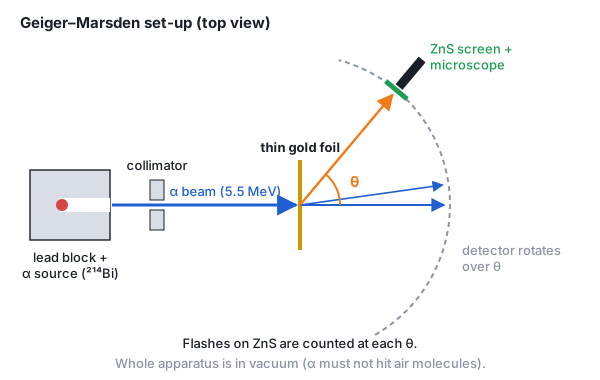
- Geiger–Marsden experiment (suggested by Rutherford, 1911): a beam of 5.5 MeV alpha particles from was aimed at a thin gold foil ( thick). A rotatable ZnS screen and microscope counted flashes at each angle .
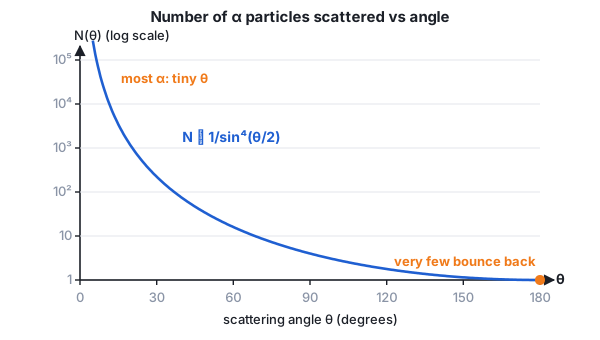
- Observations: most alpha particles went straight through; only about were scattered by more than ; about 1 in 8000 was turned back by more than .
- Conclusions: the atom is mostly empty space. All the positive charge and nearly all the mass sit in a tiny nucleus of size to , while the atom is about across.
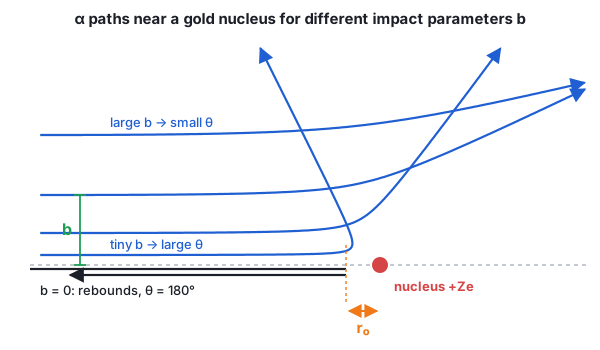
- The alpha particle (, mass u) is repelled by the gold nucleus (, ) by Coulomb's law. Gold is so heavy that the nucleus stays at rest, and the path of the alpha particle is a hyperbola.
- Impact parameter : perpendicular distance of the initial velocity line of the alpha particle from the centre of the nucleus. Small gives large ; is a head-on collision and the particle bounces straight back ().
- Distance of closest approach : in a head-on collision all the KE becomes electrostatic PE at . For a 7.7 MeV alpha on gold, , which is an upper limit to the size of the gold nucleus.
- Rutherford's planetary model: electrons revolve round the nucleus, and the Coulomb attraction provides the centripetal force. For hydrogen , , . Negative means the electron is bound.
- Failure: a revolving electron is accelerating, so by classical electromagnetism it must radiate, lose energy, spiral into the nucleus and give a continuous spectrum. Real atoms are stable and give line spectra.
Formulas
- Coulomb repulsion between alpha particle and nucleus
- Distance of closest approach; = initial KE of the alpha particle
- Impact parameter for scattering angle
- Electron orbit in hydrogen (Rutherford model)
- So and
Tips, tricks and hacks
Common mistakes
✗ At the distance of closest approach the alpha particle has some KE left.
✓ Only for . In a head-on collision it stops momentarily, so all KE becomes PE: that is how is defined.
✗ Large-angle scattering shows the nucleus is large.
✓ It shows the positive charge is concentrated in a very small region; a spread-out charge (Thomson) cannot give a strong enough push.
✗ is the exact radius of the nucleus.
✓ It only gives an upper limit; the alpha particle does not actually touch the nucleus at 5–8 MeV.
NEET traps
"The alpha path is a parabola" is wrong: under a repulsive inverse-square force from a fixed nucleus, it is a hyperbola.
A thin foil is used so that each alpha particle is scattered by just one nucleus; NEET asks why the foil must be thin.
Rutherford's model explains the nucleus but NOT the stability of the atom or the line spectrum. Options that credit it with line spectra are wrong.
Quick check: An alpha particle with kinetic energy approaches a nucleus of atomic number head-on and gets within . If the kinetic energy is doubled and the target is changed to a nucleus with atomic number , the new closest distance is
Answer: A. , so new .
Topic 2 · 🔒
Bohr model and hydrogen spectrum
Key points, graphs, every formula, tricks, common mistakes and NEET traps for this topic are inside Dhruv.
Start freePractise Atoms questions
Topic-wise practice from Level 1 to Level 3, NCERT-based questions and NEET PYQs, with a full solution after every answer.
Start practising free