Class 12 Physics · NCERT notes for NEET
Nuclei: NCERT Notes, Formulas and Tricks for NEET
What a nucleus is made of, how big it is, why it holds together (binding energy) and how fission and fusion release energy. NEET questions here are usually on binding energy per nucleon, nuclear radius or a Q-value.
Topic 1 is open for everyone. The full chapter, quick revision and practice open with a plan, or start free with 5 full chapters.
Open the interactive version (simulations and tap-to-answer quick checks).
Topic 1
Nuclear size, mass defect and binding energy
A teaspoon of pure nuclear matter would weigh about a billion tonnes, and every nucleus, from hydrogen to uranium, has this same density.
- A nucleus has protons and neutrons (together called nucleons). Mass number ; we write , e.g. .
- Atomic mass unit: of the mass of a atom , and its energy equivalent is .
- Radius with . So volume and nuclear density is the same for all nuclei.
- Mass defect: a nucleus weighs less than its separate nucleons, . Binding energy is the energy needed to pull it fully apart.
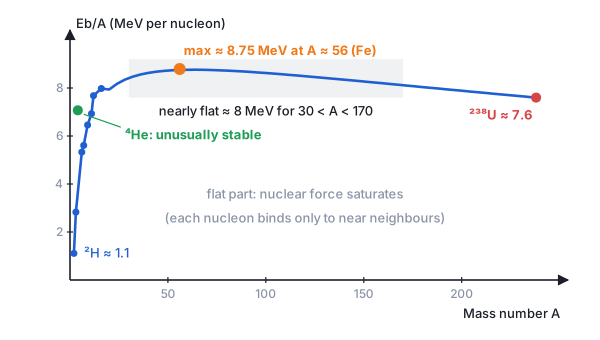
- NCERT example: has , so , i.e. about per nucleon.
- Binding energy per nucleon measures stability. It is small for light nuclei, nearly constant () for , maximum at and about at .
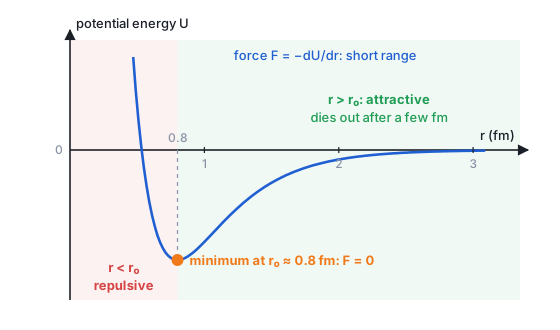
- Nuclear force: strongest force, short range (a few fm), attractive beyond about and repulsive closer, nearly the same for p-p, n-n and n-p, and saturating (each nucleon pulls only its neighbours).
- Saturation is why stays flat in the middle; Coulomb repulsion between many protons is why it drops for heavy nuclei.
Formulas
- Radius depends only on mass number
- Nuclear density, independent of ( = nucleon mass)
- Mass defect; = nuclear mass
- Binding energy
- Binding energy per nucleon; higher means more stable
- Mass-energy equivalence;
Tips, tricks and hacks
Common mistakes
✗ Larger total binding energy means a more stable nucleus.
✓ Stability depends on binding energy per nucleon; heavy nuclei have big but lower .
✗ Nuclear radius is proportional to , so a nucleus 8 times heavier is 8 times larger.
✓ : 8 times the mass gives only 2 times the radius.
✗ Mass defect means the nucleons lose some mass when they are inside.
✓ The bound system as a whole has less energy; the missing mass equals the binding energy released when it formed.
✗ Nuclear force is stronger between two protons because they are charged.
✓ Nuclear force is charge independent; p-p, n-n and n-p are about equal. Only the Coulomb part differs.
NEET traps
"Nuclear density increases with mass number": FALSE. Density is the same () for all nuclei.
"Binding energy is the energy released when nucleons combine" and "energy needed to separate them" are both correct statements of the same quantity.
NEET may give atomic masses (with electrons); when is used in place of , the electron masses cancel and the answer is the same.
Quick check: The radius of is 3.6 fm. The radius of is about
- 6.0 fm
- 16.7 fm
- 4.6 fm
- 8.0 fm
Answer: A. : , so fm.
Topic 2 · 🔒
Nuclear fission and fusion
Key points, graphs, every formula, tricks, common mistakes and NEET traps for this topic are inside Dhruv.
Start freePractise Nuclei questions
Topic-wise practice from Level 1 to Level 3, NCERT-based questions and NEET PYQs, with a full solution after every answer.
Start practising free